GOD EXAMINEDBible← Back to The Proof
★ Special Study · The Reciprocity Chain · God → You → Yourself → Others

The Same Chain, Further Down

A companion to “How God Deals With Us.” That study showed how God relates to you. This one shows that the dynamics don’t stop at you: you re-run the identical patterns on yourself and on everyone else — because the mind judges self and other with one shared circuit. So the measure you hand out is the measure you live inside, “unhappy with others” and “unhappy with yourself” are two readings of one dial, and only grace — received from above, then sent down — ever breaks the loop.
GOD→ YOU→ YOURSELF→ OTHERS ↺ …and the bottom rung touches the top again (Matt 25:40)
GodExamined.com · ★ SPECIAL STUDY · four parts · seven linked sections · 6 figures · 28 web-verified studies (5 per dynamic) · Scripture ESV unless noted
The whole study in one sentence

The dynamics by which God deals with you run right on down the chain — you deal with yourself, and with everyone around you, by the same measure, mirror, and grace — because the brain has one circuit for self and other; so the contempt you aim outward is contempt you are stamping inward, “if we are unhappy with others we are unhappy with ourselves” is a measurable fact and not a proverb, and the one force that breaks the loop is grace entering from outside it.

⚡ Skim it in one chain
  1. God deals with you by a measure — reciprocity, mirror, character, reversal, and finally grace (§1, condensed from the companion study). …and that measure doesn’t stop at you ↓
  2. “Love your neighbor as yourself” welds your treatment of others to your treatment of yourself — the self is the measuring unit (§2). …so the same rule runs one rung lower ↓
  3. Reciprocity, further down: the yardstick you use on others becomes the one your own conscience reads back to you — the “karma” of conscience (§3). …but why does it come back? ↓
  4. The mirror, further down: others appear to you as what you are; what you can’t forgive in them is what you can’t forgive in yourself (§4). …which turns every verdict inward ↓
  5. Judgment, further down: to condemn another is, in the same stroke, to convict yourself — the inner court (§5). …and this is not mysticism — it’s wiring ↓
  6. In the brain it is literally one circuit: you simulate others on your own hardware, the traits you assign them stick to you, and how you rate people is a readout of your own wellbeing (§6). …so the loop is real — and closed ↓
  7. Grace breaks the loop, entering from outside it, running down into self-forgiveness and out into mercy — and the chain folds back up: “as you did it to the least of these, you did it to me” (§7).
How this reads & how it’s graded. Four parts, read top to bottom. Part I condenses the companion study’s five dynamics into one page. Part II re-runs the first, second, and last of them one link lower — God→you becomes you→yourself→others. Part III is the mechanism: the actual neuroscience of why the links are welded. Every dynamic (§2–§7) carries its own “five studies that statistically support this” pack — real, web-verified neuroscience and sociology (effect sizes read from source), honesty-flagged wherever a figure sits behind a paywall. Part IV is where it lands — grace as the only exit. Claims carry honesty badges: ● Established = Scripture states it plainly, or the science is well-replicated; ◐ Model = a strong, consonant analogy/inference, not a closed proof; ○ Speculative / contested = an open or disputed claim, named honestly.
Part I
The Pattern, Established
The companion study (read it in full) resolves God’s dealings into five repeating dynamics. Here they are in one page — because the whole point of what follows is that three of them (reciprocity, mirror, grace) don’t stop at you.

§1How God Deals With You — Five Dynamics in One PageThe companion study, condensed: measure → mirror → character → reversal → grace.

Big point

Everything in the companion study reduces to five patterns — reciprocity, mirror, character, reversal, grace. Hold these five; the rest of this study takes three of them and runs them one level down the chain.

This is a recap, not the argument — each bullet links to the full treatment. The argument starts in §2, where the chain drops below the God-line.

William Blake, Jacob's Ladder
Fig. 1 — One ladder, many rungs — the traffic runs up and down. William Blake, “Jacob’s Dream” (c. 1805). Public domain, via Wikimedia Commons.

The five patterns, each a link you’ll meet again lower down.

  • Reciprocity — the measure you use is the measure used on you. Reciprocity The master rule of the Sermon on the Mount — “with the measure you use it will be measured to you” (Matt 7:2) — unfolds into six everyday forms: mercy, forgiveness, giving, judging, sowing, honoring. It is not vindictiveness; God simply takes you at your own word about what is fair, so the standard you enforce becomes the air you breathe. Run a merciless ledger on everyone and you have quietly requested that ledger for yourself. Full treatment → §1–§2.
  • Mirror — the same unchanging God is met as grace by the humble and as resistance by the proud. Mirror “With the merciful you show yourself merciful… with the crooked you make yourself seem tortuous” (Ps 18:25–26). He does not change moods; the surface you bring to him does. The same sun softens wax and bakes clay — the variable was never the sun. Full treatment → §3.
  • Character — the patterns flow from a fixed self-portrait he gave by name. Character Exodus 34:6–7 — “gracious and merciful, slow to anger, abounding in steadfast love and faithfulness.” Grace gives the unearned; mercy withholds the deserved; faithfulness and patience hold you across time; impartiality and justice make him safe. This is the source code the mirror reflects. Full treatment → §4.
  • Reversal — he overturns the world’s scoreboard. Reversal The first will be last; lose your life to find it; the greatest is the servant. The path that looks like losing in the world’s accounting is often the one that wins in his — so his dealings constantly invert the rankings we assume. Full treatment → §5.
  • Grace — the one asymmetry that breaks the pattern. Grace “He does not deal with us according to our sins, nor repay us according to our iniquities” (Ps 103:10). The measure is laid on Christ instead of on us. Reciprocity shows you need an exit; grace is the exit — and, as Part IV will show, it is the only thing that can enter the chain from outside and break its loop. Full treatment → §6.
→ §2 Those five describe God → you. Now the claim of this whole study: reciprocity, mirror, and grace do not stop at you. They run one rung further down — into how you treat yourself and others — and the hinge that drops them there is a single phrase Jesus quoted as the second-greatest command.
Part II
The Same Chain, Further Down
Three dynamics, re-run one link lower. The hinge (§2) welds your treatment of others to your treatment of yourself; then reciprocity (§3), the mirror (§4), and judgment (§5) each turn out to be the same motion aimed in a different direction.

§2The Hinge — “As Yourself” Welds the LinksThe second-greatest command makes self-regard the measuring unit for neighbor-regard — one dial, not two.

Big point

The command that governs how you treat others uses your treatment of yourself as its unit of measure — “love your neighbor as yourself.” Inward and outward are not two settings you can run separately; they are one dial. That is the hinge on which the whole chain swings down.

Before any psychology, Scripture has already bolted the links together — vertically (God–you) and horizontally (you–others) — and declared it a single circuit that cannot be broken in the middle.

Van Gogh, The Good Samaritan (after Delacroix)
Fig. 2 — “Love your neighbor as yourself” made visible — the measure you’d want for yourself, extended to a stranger. Vincent van Gogh, “The Good Samaritan (after Delacroix)” (1890). Public domain, via Wikimedia Commons.

The hinge is a single phrase: “as yourself.”Hinge● Established

  • “As yourself” makes self-regard the measuring stick for neighbor-regard. The second-greatest command is not “love your neighbor” but “love your neighbor as yourself” (Lev 19:18; Mark 12:31). It does not command self-love; it presupposes it — the automatic instinct to feed, shelter, excuse, and forgive yourself — and then makes that instinct the ruler laid against everyone else. The practical consequence is exact: the quality of your love for others is capped by, and reveals, the quality of your relationship with yourself. A person secretly at war with himself hands that war, in diluted form, to everyone who comes near; a person who has made genuine peace with himself has a surplus to spend outward. The command assumes the two levels move together — which is precisely the claim this study will trace into the brain.
  • The vertical and the horizontal are welded — you cannot love God while hating your brother. John states it with no softening: “if anyone says, ‘I love God,’ and hates his brother, he is a liar; for he who does not love his brother whom he has seen cannot love God whom he has not seen” (1 John 4:20). His logic is almost physical: the brother in front of you is the test instrument for the God you can’t see, so a reading of contempt on the visible gauge exposes the invisible one as fiction. The chain refuses to be cut mid-link — love allegedly descending from God and contempt allegedly flowing out to people cannot both be live wires. This is the first proof that God→you→others is one circuit and not three separate relationships.
  • It is one measure, aimed three directions. “With the measure you use, it will be measured to you” (Matt 7:2) was spoken about judging people, yet the sentence names no restriction on the target — it states a law about the instrument, not the victim. The same yardstick you pull out for your neighbor is the one already lying against your own chest, and the one God honors in his dealings with you: three aims, one tool. That is exactly why this study can “run the chain further down” — it is not a new principle but the same sentence applied one rung lower. Pick up a harsh ruler and you have equipped all three courts at once.
Scripture "You shall love your neighbor as yourself." Lev 19:18; Mark 12:31; Matt 22:39 · "if anyone says, 'I love God,' and hates his brother, he is a liar." 1 John 4:20–21 · "with the measure you use it will be measured to you." Matt 7:2 · "Whatever you wish that others would do to you, do also to them." Matt 7:12 · "the whole law is fulfilled in one word: 'You shall love your neighbor as yourself.'" Gal 5:14
Real-life dynamic You cannot pour from a cup you’re refusing to fill. The parent who despises his own weakness is the parent least able to bear a child’s weakness; the manager who can’t forgive his own mistakes runs the team that fears making any. Flip it and the same hinge works for you: people who have genuinely received their own forgiveness are almost always the easiest in the room to be imperfect around, because they’re spending a surplus, not rationing a scarcity. The command built the coupling in centuries before anyone could image it — “as yourself” is the dial, and it only has one needle.
✦ Five studies that statistically support this Real, web-verified citations (effect sizes read from source where possible). A ⚠ flag = figure confirmed in direction only; the exact number is paywalled and was not guessed.
  1. Self-compassion for your own flaws predicts accepting others’ flaws — and in couples it carries through to the partner.
    own-flaw ↔ other-flaw acceptance r = .35 (N=127) & r = .43 (N=401); self-compassion → own-flaw b = .56 → partner-flaw b = .33 (p = .005)
    ▸ In plain English
    • They measured how kindly people treat their own flaws and how readily they accept flaws in others — in students, then 401 adults, then 89 real couples.
    • Accepting your own flaws and accepting others’ flaws were moderately-to-strongly linked (r = .35, then .43) — clearly related, not coincidence.
    • In couples it ran as a chain: self-compassion strongly raised self-acceptance (b = .56), which then raised acceptance of the partner (b = .33).
    • p = .005 means roughly a 1-in-200 chance that partner link is a fluke — statistically solid.
    • Takeaway: the kindness you extend inward is the same supply you draw on to bear with the person beside you.
    Zhang, Chen & Tomova Shakur (2020). “From Me to You.” Pers. Soc. Psychol. Bulletin 46(2):228–242.
  2. People higher in self-compassion forgive others more and take others’ perspective more.
    self-compassion ↔ forgiving others r = .28 / .33 / .51; ↔ perspective-taking r = .30 / .31 / .44 (undergrads / adults / meditators; total N = 956)
    ▸ In plain English
    • Across 956 people in three groups (students, community adults, meditators) they checked whether self-kindness tracks concern for others.
    • People kinder to themselves forgave others more — a link that grew from modest (r = .28) to strong (r = .51) with maturity and practice.
    • Same for perspective-taking (seeing another’s side): r = .30 up to .44 — self-compassion and understanding-others rise together.
    • Honest limit (⚠): among young undergrads the broadest “compassion for all humanity” items showed no significant link — the coupling strengthens with age.
    • Takeaway: inward gentleness and outward forgiveness are not opposites; they climb together.
    Neff & Pommier (2013). Self and Identity 12(2):160–176. ⚠ broad compassion-for-humanity links n.s. in undergrads; grow with maturity
  3. The disposition to forgive yourself travels with the disposition to forgive others.
    self-forgiveness ↔ other-forgiveness r = .31 (N=1,111), .32 (N=504), .35 (N=123), all p < .001
    ▸ In plain English
    • Using a standard forgiveness scale on three big samples (over 1,700 people), they separated “forgiving yourself” from “forgiving others.”
    • The two were distinct but reliably correlated — r around .31–.35, a consistent moderate link in every sample.
    • “p less than .001” means under a 1-in-1,000 chance it’s random — and it replicated three separate times.
    • That repetition across independent samples is the real strength: the same coupling kept reappearing.
    • Takeaway: “let yourself off the hook” and “let your neighbor off the hook” are measurably one trait turned two ways.
    Thompson et al. (2005). “Dispositional Forgiveness of Self, Others, and Situations.” J. Personality 73(2):313–359.
  4. Self-regard and relationship quality predict each other prospectively — a two-way feedback loop.
    meta-analysis: self-esteem → later relationships β = .08 (N=21,995); relationships → later self-esteem β = .08 (N=46,231); concurrent r = .28
    ▸ In plain English
    • A meta-analysis pooled dozens of long-term studies — tens of thousands of people tracked over time.
    • At any one moment, how you feel about yourself and how good your relationships are correlate at r = .28 (a solid medium link).
    • Over time it runs both ways equally (β = .08 each): higher self-esteem predicts better later relationships, and vice-versa.
    • β = .08 is small per step, but across ~68,000 people it’s a genuine prospective effect that compounds as a loop.
    • Takeaway: self-regard and love-of-others lift each other in a spiral — exactly what “as yourself” implies.
    Harris & Orth (2020). “The Link Between Self-Esteem and Social Relationships.” J. Pers. Soc. Psychol. 119(6):1459–1477.
  5. Across the whole literature, self-compassion spills into actual prosocial behavior toward others.
    multilevel meta-analysis: 59 studies, 74 samples, N = 39,625, 369 effects — “small-to-medium positive” (self-warmth drives it)
    ▸ In plain English
    • The largest synthesis to date combined 59 studies and nearly 40,000 people (369 separate results).
    • It asked the behavioral question: do self-compassionate people actually do more kind things for others (not just feel it)?
    • Answer: yes — a small-to-medium positive association with real prosocial behavior.
    • The warm side of self-compassion drove it; the self-critical/cold side did not — it’s the kindness, not leniency, that spills over.
    • Honest limit (⚠): the exact pooled number is paywalled, but the huge sample and the positive direction are confirmed.
    Liu et al. (2025). Personality and Individual Differences 236:113019. ⚠ exact pooled r paywalled; samples & direction verified
→ §3 If self and other move on one dial, then the first dynamic — reciprocity — must run below the God-line too. Watch the “measure you use” stop needing God to enforce it at the human level: your own conscience runs it automatically.

§3Reciprocity, Further Down — the Karma of Your Own ConscienceThe standard you hold others to becomes the standard your inner court holds you to — a self-executing loop.

Big point

The measure-rule doesn’t wait for God to enforce it between people — your own conscience runs it automatically. The standard you hold others to becomes the standard your inner court reads back to you: you install your own judge, write your own law, and then stand trial under it. That is the honest, non-mystical core of “karma.”

Not cosmic bookkeeping — a self-executing loop inside one mind. Scripture names both the slow outer version (sowing and reaping) and the fast inner one (the conscience that accuses or excuses).

1 · Judge a man by a harsh rule and you have just written the law your own conscience will read back to you.Reciprocity● Established

  • The act of judging installs a standard, and a standard has jurisdiction over the one who raised it. Paul’s line is sharper than “don’t be a hypocrite”: “in passing judgment on another you condemn yourself, because you, the judge, practice the very same things” (Rom 2:1). The point is structural — you cannot hold a rule over others and secretly exempt yourself from it inside your own head, because the mind does not keep two rulebooks, one for “them” and a softer one for “me.” The category you define to condemn another (“people who are weak / phony / selfish”) is a category you are inescapably a member of in some mood or season. So the harshest critic you will ever live under is the one you are building: yourself. The severity you practice on others is the severity you are rehearsing for your own 3 a.m. tribunal.
  • The conscience is a courtroom furnished by the verdicts you hand down. Paul describes it as a live faculty: conscience “bears witness, and their conflicting thoughts accuse or even excuse them” (Rom 2:15). Every judgment you pass on others is a precedent entered into your own case law — a lifetime of merciless verdicts furnishes a merciless inner courtroom, while a habit of mercy slowly furnishes a gentler one. This is the real engine behind “karma”: not that the universe keeps a ledger and repays you, but that you are continuously training the voice that will one day try you. Proverbs states the mechanism in a single line: “a man who is kind benefits himself, but a cruel man hurts himself” (Prov 11:17). The benefit and the hurt are collected first, and most reliably, by the one generating them.
  • Cruelty and kindness are self-administered before they ever reach the target. Any act of contempt requires you to first manufacture contempt inside your own body — the clenched jaw, the spike of arousal, the acid narrative — and you marinate in that chemistry before the other person feels a thing. The “cruel man hurts himself” literally: he lives inside the physiology of cruelty for as long as he holds it. The kind man “benefits himself” the same way, inhabiting a different internal climate entirely. You are always the first, nearest, and longest-exposed recipient of whatever you send out — a fact §6 will show is not poetry but blood chemistry.
Scripture "in passing judgment on another you condemn yourself… you, the judge, practice the very same things." Rom 2:1 · "their conscience also bears witness, and their conflicting thoughts accuse or even excuse them." Rom 2:15 · "A man who is kind benefits himself, but a cruel man hurts himself." Prov 11:17 · "whatever one sows, that will he also reap." Gal 6:7 · "Whoever digs a pit will fall into it; a stone comes back on him who starts it rolling." Prov 26:27 · "As you have done, it shall be done to you; your deeds shall return on your own head." Obadiah 15
Real-life dynamic The rule you enforce becomes the rule you live under — first of all in your own head. The colleague who sneers at everyone who gets laid off, who “should have seen it coming,” is building the exact script that will flay him the day it’s his desk being cleared. The friend endlessly disgusted by other people’s failed diets, messy divorces, and bad parenting is quietly constructing a prosecutor who will give him no quarter when his own turn comes. And the reverse is just as real: people who extend the benefit of the doubt as a habit discover they have a gentler judge waiting for them in the dark — because they trained it.
✦ Five studies that statistically support this The giver is the first recipient: kindness benefits the sender, propagates outward, and hostility harms the hostile person’s own body. ⚠ = direction verified, exact figure paywalled.
  1. Spending on others makes you happier than spending the same on yourself — and the amount doesn’t matter.
    randomized field experiment, N = 46; prosocial-spending group significantly happier by day’s end; $5 vs $20 — no difference
    ▸ In plain English
    • Researchers handed people money and randomly told some to spend it on themselves, others on someone else, then measured happiness that evening.
    • Those assigned to spend on others were happier by day’s end — the giving itself produced the lift.
    • The amount ($5 vs $20) made no difference — the direction of spending mattered, not the size.
    • Because assignment was random, this shows giving causes happiness, not just that happy people give.
    • Takeaway: kindness spent outward is deposited straight back into your own wellbeing.
    Dunn, Aknin & Norton (2008). “Spending Money on Others Promotes Happiness.” Science 319(5870):1687–1688.
  2. Performing acts of kindness reliably raises the doer’s own well-being.
    meta-analysis: 27 studies, N = 4,045; effect of kindness on the actor’s well-being δ = 0.28 (not moderated by age, sex, or act type)
    ▸ In plain English
    • A meta-analysis pooled 27 experiments (4,045 people) where some were assigned to perform acts of kindness.
    • Doing kindness reliably raised the doer’s own wellbeing — effect size δ = 0.28, a small-to-medium, dependable bump.
    • It held regardless of the doer’s age, sex, or the type of kind act — the effect is general, not niche.
    • Because kindness was assigned, the causal arrow runs kindness → happiness.
    • Takeaway: being kind is one of the most reliable self-administered mood boosts there is.
    Curry et al. (2018). “Happy to help?” J. Experimental Social Psychology 76:320–329.
  3. Volunteering lowers your mortality — but only when the motive is genuinely other-oriented.
    N = 10,317; 4-yr mortality 1.6% (other-oriented volunteers) vs 4.0% (self-oriented) vs 4.3% (non-volunteers); regular volunteering OR = 0.52
    ▸ In plain English
    • Over 10,000 older adults were tracked for 4 years, logging who volunteered and why.
    • Regular volunteers had about half the death risk of non-volunteers (odds ratio 0.52 — roughly 48% lower).
    • The twist: only other-oriented volunteers benefited (1.6% died); self-serving volunteers died like non-volunteers (4.0% vs 4.3%).
    • So the life-extending benefit tracks the sincerity of the outward motive, not the activity itself.
    • Takeaway: genuine kindness lengthens the giver’s life; self-serving “giving” earns nothing.
    Konrath et al. (2012). “Motives for Volunteering Are Associated With Mortality Risk.” Health Psychology 31(1):87–96.
  4. One cooperative act cascades through the network, making strangers kinder to still other strangers.
    each unit you contribute is roughly tripled through those you influence; the effect propagates up to three degrees of separation
    ▸ In plain English
    • In repeated cooperation games (partners reshuffled each round) they tracked how one person’s generosity spread.
    • Each extra unit you contributed got roughly tripled as the people you influenced cooperated with still others.
    • The ripple reached three degrees of separation — your kindness touched friends of friends of friends.
    • This is “upstream reciprocity”: you’re not repaid by the one you helped, but the kindness circulates back through the network.
    • Honest limit (⚠): effect sizes verified; the exact N of the re-analyzed dataset wasn’t reconfirmed.
    Fowler & Christakis (2010). “Cooperative behavior cascades…” PNAS 107(12):5334–5338. ⚠ reanalyzed-dataset N not reconfirmed
  5. Hostility sent outward comes back into the hostile person’s own heart.
    meta-analysis: anger/hostility → incident heart disease HR = 1.19 (95% CI 1.05–1.35; 25 studies); worse prognosis HR = 1.24 (1.08–1.42; 19 studies)
    ▸ In plain English
    • Two meta-analyses pooled dozens of long-term studies on anger/hostility and the heart.
    • In healthy people, high hostility raised future heart-disease risk by about 19% (hazard ratio 1.19).
    • In people who already had heart disease, hostility worsened their outcome by about 24% (HR 1.24).
    • The confidence ranges (1.05–1.35; 1.08–1.42) stay above 1.0, so the harm is statistically real, not noise.
    • Takeaway: the cruelty you carry attacks your own body first — “a cruel man hurts himself,” in cardiac events.
    Chida & Steptoe (2009). J. American College of Cardiology 53(11):936–946.
Honest caveat — on the word “karma.”
  • This is not the metaphysical karma of rebirth and a cosmic moral ledger that balances across lifetimes ○ not the claim — Scripture rejects that frame, and nothing here depends on it.
  • What is being claimed has two honest parts: a slow outer law — sowing and reaping, a real if delayed social and relational feedback (Gal 6:7) ◐ Model; and a fast inner law — the self-executing conscience (Rom 2:15) that the neuroscience in §6 directly supports ● Established.
  • So “the karma of your own conscience” means: the loop that reliably returns your measure to you is the one running inside your own skull — not a universe keeping score, but a mind keeping shape.
→ §4 But why does the measure come back — what mechanism hands it to you? The second dynamic answers it: the mirror. Other people are, to a startling degree, a surface returning your own reflection.

§4The Mirror, Further Down — Others Are Your ReflectionYou meet in people what you carry in; what you can’t forgive in them is often what you can’t forgive in yourself.

Big point

The same mirror that makes the proud meet God as cold and the humble meet him as kind operates between you and other people: you largely meet, in them, what you bring into the room. And the faults that most enrage you in others are disproportionately the ones you can’t forgive in yourself — so people become a screen onto which your own disowned material is projected and then punished at a safe distance.

Perception is constructed, not received. What you carry has already half-decided what you’ll find — which is why your reading of other people is, to a measurable degree, a self-portrait.

Caravaggio, Narcissus
Fig. 3 — The figure leans toward a face he takes for another — and it is his own reflection. The picture of a mind that falls for, and fights with, itself in others. Caravaggio, “Narcissus” (c. 1597–99). Public domain, via Wikimedia Commons.

You meet in others what you bring to them — the mirror is sideways too.Mirror● Established

  • “To the pure, all things are pure, but to the defiled… nothing is pure.” Paul’s line (Titus 1:15) is a precise account of how perception works: the suspicious person walks into a world of schemers, the contemptuous person into a world of idiots, the frightened person into a world of threats — not because the world rearranged itself for each of them, but because the mind builds what it sees out of its own contents. The same colleague reads as “helpful” to the secure employee and “condescending” to the insecure one; the same silence reads as peace to the trusting spouse and as rejection to the anxious one. The data in §6 will name this a perceiver effect and show it is stable enough to predict your personality a year later. What you carry has already tinted the glass before anyone’s face appears in it.
  • What you cannot forgive in others is usually what you cannot forgive in yourself. ◐ Model The traits that trigger the hottest contempt — laziness, neediness, phoniness, arrogance, cowardice — are frequently the very ones a person has disowned in himself and is now hunting “out there,” where they can be condemned at no personal cost. This is the old idea of projection; in its strong Freudian form it is contested, but a reliable tell survives the debate: intensity. Ordinary disagreement does not burn; it is the mirror that burns — the flash of disproportionate heat is the signal that you are looking at your own disowned reflection. Jesus’ image is exact: the “speck” you are so eager to operate on in your brother’s eye is the small outer copy of the “log” you will not turn and look at in your own (Matt 7:3–5).
  • Because others mirror you, your rating of them is a readout of you. Here is the hinge of this whole study, previewed from §6: how positively or negatively you tend to see people in general tracks your own wellbeing and character far more than it tracks theirs. The chronically contemptuous person is not filing an accurate report on humanity; he is broadcasting the weather inside his own skull and mistaking it for the climate outside. “If we are unhappy with others we are unhappy with ourselves” is therefore not a greeting-card sentiment — it is the plain reading of a gauge that, physically, can only show one thing at a time.
Scripture "To the pure, all things are pure, but to the defiled… nothing is pure; both their minds and consciences are defiled." Titus 1:15 · "Why do you see the speck in your brother's eye, but do not notice the log in your own?" Matt 7:3–5 · "with the crooked you make yourself seem tortuous." Ps 18:26 · "The good person out of the good treasure of his heart produces good… for out of the abundance of the heart his mouth speaks." Luke 6:45 · "Keep your heart with all vigilance, for from it flow the springs of life." Prov 4:23
Real-life dynamic The thing that enrages you about someone is often a letter addressed to you. The man most viscerally disgusted by “try-hards” is usually terrified of his own hunger to be seen; the woman who cannot stand “needy” friends is often strangling her own unmet needs. Notice what flips you from disagreement to contempt — that heat is the mirror, not the person. Couples prove the law in miniature: the trait each most despises in the other is frequently the one each most fears in himself, which is why the fight never resolves on the facts — it was never really about the facts.
✦ Five studies that statistically support this Your read on other people is measurably a projection of your own contents. ⚠ = direction verified, exact figure paywalled.
  1. How positively you rate people in general is a stable trait that tracks YOUR wellbeing and dark traits — the literal “projective test.”
    positivity-of-perceptions perceiver ICC = .38; ↔ own life-satisfaction r = .11; depressed raters see others less agreeable (r = −.09) / less stable (r = −.12); narcissism → lower ratings on every Big Five trait (r ≤ −.11)
    ▸ In plain English
    • They had people rate others’ personalities and isolated the perceiver effect — the rater’s consistent tilt, apart from who’s being rated.
    • That tilt is large and stable: 38% of a personality rating (ICC = .38) is about the rater, not the target.
    • Happier raters saw others more positively (r = .11); depressed raters saw others as less agreeable (−.09) and less stable (−.12).
    • Narcissists rated others lower on every trait (all r ≤ −.11) — a dark interior paints a dark world.
    • Takeaway: your verdict on people is a projective test of you — the measured form of “unhappy with others = unhappy with self.”
    Wood, Harms & Vazire (2010). “Perceiver effects as projective tests.” J. Pers. Soc. Psychol. 99(1):174–190.
  2. A large fraction of what you “see” in another’s personality is contributed by you, the perceiver.
    perceiver effects ≈ 20–30% of the variance in personality judgments; assumed similarity is trait-specific, not a vague halo
    ▸ In plain English
    • Across two real-interaction studies they measured how much of a personality judgment comes from the perceiver.
    • Roughly 20–30% of the variance in what you “see” in someone is contributed by you, not them.
    • You also assume others resemble you trait-by-trait (not a vague halo) — your self is the template.
    • That chunk of “them” that is really “you” is stable, so it’s a trait of the perceiver, not a passing mood.
    • Honest limit (⚠): exact per-trait numbers are paywalled; the ~20–30% magnitude and direction are confirmed.
    Srivastava, Guglielmo & Beer (2010). J. Pers. Soc. Psychol. 98(3):520–534. ⚠ exact per-trait r paywalled; variance magnitude verified
  3. You assume others share your own choices and read the differing as deviant (false-consensus effect).
    those who agreed to wear a sign estimated 62.2% of peers would too; those who refused estimated only 33.0% (F = 26.47)
    ▸ In plain English
    • Students were asked to walk campus wearing a sandwich-board sign, then estimate how many peers would agree.
    • Those who agreed guessed 62.2% of peers would too; those who refused guessed only 33.0%.
    • Each camp projected its own choice onto everyone else — a 29-point gap (F = 26.47).
    • The gap is large and highly significant — a robust, repeatable bias across all four studies.
    • Takeaway: your read on “what everyone’s like” is built out of what you are like.
    Ross, Greene & House (1977). “The ‘false consensus effect.’” J. Experimental Social Psychology 13(3):279–301.
  4. Hostile people read hostile intent into others’ neutral behavior — they see the hostility they carry.
    meta-analysis: 41 studies, N = 6,017; hostile-attribution ↔ aggression r = .17 (Z = 11.25, p < .001)
    ▸ In plain English
    • A meta-analysis pooled 41 studies (6,017 people) on “hostile attribution bias.”
    • Hostile people systematically read hostile intent into others’ neutral or ambiguous acts (r = .17 with aggression).
    • r = .17 is modest, but with Z = 11.25 across 6,000 people it’s rock-solid — and larger for severe aggression.
    • The hostility is in the eye of the beholder: the same ambiguous bump reads as an “attack” to the aggressive mind.
    • Takeaway: “to the defiled nothing is pure” — a hostile interior manufactures hostility out of neutral facts.
    Orobio de Castro et al. (2002). “Hostile attribution and aggressive behavior.” Child Development 73(3):916–934.
  5. Projecting a feared trait onto someone else actively lowers your own awareness of it — projection working as a defense.
    2 experiments (anger, dishonesty): participants allowed to project a feared trait then showed the lowest self-accessibility of that trait
    ▸ In plain English
    • In two experiments, people were made to fear they had a bad trait (hidden anger, then dishonesty).
    • Those allowed to project it onto someone else afterward showed the lowest awareness of it in themselves.
    • So projection “works”: accusing others of your fault quietly muffles your own sense of carrying it.
    • This is direct experimental evidence (not just theory) that we externalize disowned material onto those we judge.
    • Honest limit (⚠): exact F-values are paywalled; the design and direction of the result are confirmed.
    Schimel, Greenberg & Martens (2003). Pers. Soc. Psychol. Bulletin 29(8):969–979. ⚠ exact F paywalled; design & direction verified
→ §5 If other people reflect you, then the sharpest form of the mirror — judgment — must reflect hardest of all. To pass sentence on them, watch what you are forced to do to yourself first.

§5Judgment, Further Down — Condemn Them, Convict YourselfTo judge, you must run others on your own moral hardware — so the verdict is filed against you.

Big point

Judging another is not a neutral observation about them; it is an act that, in the same motion, passes sentence on you — because to judge you must first run them on your own moral hardware, and the verdict is recorded against the only person whose file the brain is actually keeping: you.

This is where reciprocity and mirror converge into one blade. The sentence you aim outward is filed inward — and because it is a trained reflex, it does not respect targets.

Domenico Fetti, The Parable of the Mote and the Beam
Fig. 4 — Operating on the speck in a brother’s eye with a beam in your own — the exact picture of judgment that can’t see itself. Domenico Fetti, “The Parable of the Mote and the Beam” (c. 1619). Public domain, via Wikimedia Commons.

The sentence you pass outward is filed inward — and the reflex doesn’t respect targets.Judgment● Established

  • You cannot condemn a kind of person without indicting the category you belong to. “Judge not, and you will not be judged” (Luke 6:37); “there is only one lawgiver and judge… who are you to judge your neighbor?” (James 4:11–12). The structural trap is that condemnation requires a category — “that kind of person” — and you are inescapably a member of some category you condemn, if not today then in the season you’d rather forget. This is why the stone-ready crowd drops its rocks the instant Jesus says “let him who is without sin among you be the first to throw” (John 8:7): the woman did not suddenly become innocent, but the ruler turned around in their hands and they saw it was pointed at themselves. Every stone you pick up for someone else is weighed, first, in your own hand.
  • Contempt is a trained circuit, and a trained circuit fires wherever it’s pointed — including inward. ◐ Model By the basic Hebbian principle — neurons that fire together wire together — rehearsing contempt daily (at other drivers, other politicians, other relatives, the stranger online) does not merely express an opinion; it strengthens a default appraisal that fires faster and at a lower threshold each time. A reflex that practiced cannot be kept politely aimed outward; it becomes the first lens the mind reaches for, and it is still loaded when the mind turns on you at 3 a.m. You are, with every outward verdict, rehearsing the exact response that will one day be used on yourself — which is why the most savage inner critics are so often the most practiced outer ones.
  • So the harsh get harsh in both directions at once — it is one setting on one dial. The person famous for flaying others is almost never quietly gentle with himself in private; the self-flagellating perfectionist is almost never genuinely patient with other people’s mistakes. They are not two problems but one setting read on two gauges. This is why “stop condemning other people” and “stop savaging yourself” turn out to be the same instruction — and why mercy, once genuinely received, loosens both grips in the same motion. You do not fix the outward reading by trying harder to be nice; you change the setting, and both needles move.
Scripture "Judge not, and you will not be judged; condemn not, and you will not be condemned." Luke 6:37 · "with the judgment you pronounce you will be judged." Matt 7:1–2 · "There is only one lawgiver and judge… who are you to judge your neighbor?" James 4:11–12 · "Let him who is without sin among you be the first to throw a stone." John 8:7 · "Who are you to pass judgment on the servant of another?" Rom 14:4,10
Real-life dynamic The knife you sharpen on others is the one that’s waiting for you. The man who gleefully joins the online mob dragging a stranger teaches a whole crowd exactly how to read a person uncharitably — and a year later, when an old message of his surfaces stripped of context, the same crowd comes with the same ruler and the same glee. He didn’t just make enemies; he trained the instrument. And privately it’s identical: the voice you’ve spent years aiming at other people’s failures is the voice that narrates your own in the dark, in the same tone, because it is literally the same voice.
✦ Five studies that statistically support this A harsh stance is one trained “setting” that aims at others and the self at once. ⚠ = direction verified, exact figure paywalled.
  1. Dispositional contempt is ONE stable trait that points harshly outward AND inward at the self at once.
    outward: r = .48 (other-oriented perfectionism), .51 (narcissistic exploitativeness), .28 (narcissism); inward: r = −.25 (self-esteem), .25 (shame); 1-month stability r = .75 (N = 227)
    ▸ In plain English
    • They built and validated a dispositional-contempt scale — the stable habit of looking down on people — in 227 adults.
    • It pointed outward: tied to demanding perfection of others (r = .48) and exploiting them (r = .51).
    • It also pointed inward: contemptuous people had lower self-esteem (r = −.25) and more shame (r = .25).
    • It’s a durable trait, not a mood: steady over a month (r = .75) — one fixed setting aimed both ways.
    • Takeaway: the same contempt-dial scorns others and the self at once — “one setting, two gauges.”
    Schriber, Chung, Sorensen & Robins (2017). “Dispositional contempt.” J. Pers. Soc. Psychol. 113(2):280–309.
  2. Describing others’ negative traits automatically re-describes YOU with those traits — and warnings can’t stop it.
    trait transference F(1,62) = 109.38, p < .0001; persisted despite explicit warning to resist (F(1,210) = 1.48, p = .22, n.s.) — automatic, not reasoned
    ▸ In plain English
    • People heard someone describe a third party’s bad behavior, then rated the describer.
    • The describer got stuck with the very traits they described — a huge effect (F = 109.38; near-zero odds of chance).
    • When warned not to do it, nothing changed (F = 1.48, not significant) — proof it’s automatic.
    • Because warnings can’t switch it off, it’s involuntary associative “gluing,” not a judgment you can police.
    • Takeaway: the dirt you throw at others sticks to you — in your mind and theirs — automatically.
    Carlston & Skowronski (2005). “Linking versus thinking.” J. Pers. Soc. Psychol. 89(6):884–898.
  3. Judging the self and judging others are not separate operations — they share the brain’s appraisal network.
    meta-analysis of 107 neuroimaging studies: both recruit medial prefrontal cortex (+ left TPJ, posterior cingulate), differing only as a ventral→dorsal gradient
    ▸ In plain English
    • A meta-analysis combined 107 brain-imaging studies of people judging themselves vs. judging others.
    • Both kinds of judgment lit up the same core region (medial prefrontal cortex, plus two others).
    • Self vs. other differed only as a slight front-to-back gradient within that one region — not separate machinery.
    • So there’s no sealed-off “department” for judging other people; it runs on the hardware that also holds you.
    • Takeaway: to convict another you fire the exact circuit that also files the verdict on yourself.
    Denny, Kober, Wager & Ochsner (2012). J. Cognitive Neuroscience 24(8):1742–1752.
  4. Demanding perfection OF OTHERS rides with hostility; demanding it only of yourself does not.
    3 samples (N = 318 / 417 / 398): other-oriented & socially-prescribed perfectionism → interpersonal hostility, aggression, distrust; self-oriented → null/negative
    ▸ In plain English
    • Across three samples (over 1,100 people) they split perfectionism into demanding-of-others vs. demanding-of-self.
    • Demanding perfection of others (and feeling others demand it) tied to hostility, aggression, and distrust.
    • Demanding it only of yourself did not — it went null or negative once the overlap was removed.
    • So the relationship-damaging harshness is specifically the outward-aimed standard.
    • Honest limit (⚠): exact coefficients paywalled; direction, design, and significance confirmed (a 2015 companion agrees).
    Stoeber et al. (2017). “Perfectionism, social disconnection, and interpersonal hostility.” Pers. Individ. Differ. 119:112–117. ⚠ exact r/β paywalled; direction & design verified
  5. People high in trait self-criticism behave, in real daily life, with less warmth and more quarrelsomeness toward others.
    event-contingent diary, N = 119 adults over 20 days: trait self-criticism → low communion (less agreeable, more quarrelsome behavior toward others)
    ▸ In plain English
    • 119 working adults logged their real social interactions for 20 days — not just a one-off questionnaire.
    • People high in trait self-criticism actually behaved with less warmth and more quarrelsomeness toward others.
    • Measured in daily life as it happened, the inward harshness showed up as outward coldness.
    • This bridges lab and life: the self-critic isn’t only hard on himself in private — he’s prickly with everyone.
    • Honest limit (⚠): exact correlation paywalled; the sample, 20-day design, and direction confirmed.
    Zuroff, Moskowitz & Côté (1999). British J. Clinical Psychology 38(3):231–250. ⚠ exact r paywalled; direction & design verified
→ §6 By now the obvious question: why is it one dial, one voice, one circuit? Because in the brain that is not a metaphor. Self and other are processed on overlapping hardware — and the lab can measure it.
Part III
How It Works in the Brain
The mechanism beneath the whole chain. The brain represents self and other with heavily overlapping circuitry, judges them with the same appraisal machinery, and literally attaches to you the traits you assign to others. “Unhappy with others = unhappy with yourself” is a measurable property of the social brain — here are the studies.

§6One Circuit for Self and Other — the MechanismShared self/other wiring, trait transference, the perceiver effect, and the one threat-vs-soothe appraisal dial.

Big point

The reason the chain runs — the reason treating others and treating yourself are one motion — is physical: the brain represents self and other on overlapping circuitry, the traits you assign to others stick to you, your rating of people is a readout of your own wellbeing, and condemnation and mercy run on one appraisal dial (threat vs. soothe) that cannot be set cruel outward and kind inward for long.

Four converging lines of evidence, each with its study. Read honestly: these are robust and convergent, but they establish a strong mechanism, not a closed proof that every judgment of others surgically wounds the self — the honesty box at the end grades exactly how far the claim reaches.
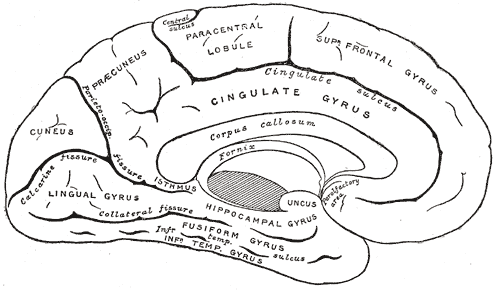
Medial surface of the cerebral hemisphere (Gray's Anatomy)
Fig. 5 — The brain’s medial wall — the midline surface (cingulate and medial frontal cortex) that houses the self-and-other “cortical midline structures” named below. Gray’s Anatomy (1918), medial surface of the cerebral hemisphere. Public domain; schematic, not a functional scan.

1 · One circuit: the brain thinks about others on the same hardware it uses for itself.Neuroscience● Established

  • Self-processing and other-processing share a neural substrate — chiefly the cortical midline structures. When you reflect on yourself (“am I honest?”) and when you reason about another mind (“is she honest?”), heavily overlapping regions light up — above all the medial prefrontal cortex (mPFC) and the posterior cingulate. Plain English: to picture what you’re like and what your neighbor is like, the brain reaches into the same drawer. Logic: if the hardware is shared, then a verdict rendered on “them” is rendered by, and leaves its residue in, the same equipment that holds “me” — there is no separate, sealed-off department for judging other people. Analogy: you cannot paint someone else’s portrait without getting paint on your own hands, because the medium is shared. Examples: you grasp a friend’s grief by simulating it and feel a real shadow of it yourself; watching another person in pain activates parts of your own pain network; rehearsing an argument “as” your opponent makes your own heart rate climb.
Study Decety, J. & Sommerville, J. A. (2003), “Shared representations between self and other: a social cognitive neuroscience view,” Trends in Cognitive Sciences 7(12):527–533. With Mitchell, Macrae & Banaji (2006), Neuron 50:655–663, showing mPFC carries judgments of both self and (similar) others. A meta-analysis of 107 neuroimaging studies — Denny, Kober, Wager & Ochsner (2012), J. Cognitive Neuroscience 24(8):1742–1752 — confirms self- and other-judgments both recruit medial prefrontal cortex, differing only as a ventral→dorsal gradient within the same region. Shared self/other substrate — replicated across 100+ studies.

If the hardware is shared, then what you say about others shouldn’t stay cleanly “about them” — and it doesn’t.

2 · What you say about others sticks to you — spontaneous trait transference.Neuroscience● Established

  • Describe someone as cruel or dishonest, and the mind binds that trait to the describer — including in your own memory. In the classic experiments, when a person described a third party as, say, hostile or incompetent, listeners unconsciously came to rate the describer as hostile or incompetent — the trait leaked from the described to the teller. Plain English: brains are sloppy about the “about” tag; the trait and the talker get glued together. Logic: if narrating cruelty wires “cruelty” into the associative network right next to your own self-node, then a life spent cataloguing other people’s flaws is a life spent quietly tagging yourself with them, one description at a time. Analogy: handle charcoal all day to point at other people’s smudges and your own hands blacken — the medium transfers. Examples: gossip reliably curdles the gossip, not just the target; the cynic who narrates everyone’s selfishness slowly cannot feel generous himself; the critic who dissects everyone at work finds he can’t switch the review off at home.
Study Skowronski, J. J., Carlston, D. E., Mae, L. & Crawford, M. T. (1998), “Spontaneous trait transference: Communicators take on the qualities they describe in others,” Journal of Personality and Social Psychology 74(4):837–848. The binding is automatic, not reasoned: in the follow-up, trait-valence transference reached F(1,62) = 109.38, p < .0001, and survived even when subjects were explicitly warned to resist it (F(1,210) = 1.48, p = .22, n.s.) — Carlston & Skowronski (2005), JPSP 89(6):884–898. The traits you assign others attach to you — automatically.

If single descriptions transfer, then your overall read on people should be a portrait of you — and it is, measurably.

3 · How you rate people in general is a readout of your own wellbeing — the perceiver effect.Neuroscience● Established

  • Your tendency to see others positively or negatively tracks your happiness and character, durably — not theirs. In a large study of how people rate the personalities of others, the perceiver’s general positivity or negativity (“perceiver effects”) correlated strongly with the perceiver’s own life-satisfaction, agreeableness, and emotional stability — while a tendency to see others negatively predicted the perceiver’s narcissism and antisocial traits, and the pattern held up a year later. Plain English: your verdict on humanity is mostly a self-portrait. Logic: if the dial that reads “others” is physically the dial that reads “self” (line 1), then a low reading outward is a low reading, full stop — which is the measured form of “if we are unhappy with others we are unhappy with ourselves.” Analogy: the tint of your sunglasses colors every face you pass; change the people, the tint stays. Examples: the chronic complainer whose misery predicts his reviews, not the restaurants’; the one-star rater of everything; the contrasting person who “likes almost everyone” and is usually at peace in his own skin.
Study Wood, D., Harms, P. & Vazire, S. (2010), “Perceiver effects as projective tests: What your perceptions of others say about you,” Journal of Personality and Social Psychology 99(1):174–190. Positivity-of-perceptions is a large, stable perceiver trait (intraclass r = .38); depressed raters judge others less agreeable (r = −.09) and less emotionally stable (r = −.12), and higher narcissism predicts rating others lower on every Big Five dimension (all r ≤ −.11). The empirical keystone for “unhappy with others = unhappy with self” (full pack in §4).

And underneath all three sits one appraisal system — the same one that decides whether a situation is a threat or a safety.

4 · Condemnation and mercy run on one dial — threat vs. soothe — and the dominant setting generalizes.Neuroscience◐ Model

  • Self-criticism engages the brain’s threat-and-error machinery; self-reassurance engages its compassion machinery — and you can’t keep one aimed in, the other out, for long. Imaging of self-criticism vs. self-reassurance finds criticism recruits the error/conflict and threat regions (lateral prefrontal cortex, dorsal anterior cingulate), while reassurance recruits regions tied to compassion and empathy (left temporal pole, insula). Compassion-focused models (Gilbert) and self-compassion research (Neff) map the same split onto a threat system (amygdala, cortisol) versus a soothing system (parasympathetic, vagal, affiliative). Plain English: condemnation — of anyone — is a threat state your body pays for in stress chemistry; mercy is a safety state. Logic: because self and other share the appraisal circuit (line 1), the dominant setting generalizes — a mind habitually in “condemn” cannot reliably flip to “be gentle” just because the target changed from a stranger to itself. Analogy: a thermostat set to “cold” cools the whole house, not one room. Examples: the perfectionist equally merciless to his own B+ and his child’s; the person who, learning self-compassion in therapy, spontaneously softens toward others without being told to; the opposite — bottled self-hatred that leaks out sideways as sarcasm and scorn.
Study Longe, O. et al. (2010), “Having a word with yourself: Neural correlates of self-criticism and self-reassurance,” NeuroImage 49(2):1849–1856. With Gilbert, P. (2009), The Compassionate Mind (threat / drive / soothing systems), and Neff, K. (2003), self-compassion research. One appraisal dial for inward and outward.

One more piece ties it to mood directly: the machine that won’t stop judging is the same one linked to unhappiness.

Footnote · The judging-and-ruminating network is the restless Default Mode Network tied to low mood.Neuroscience◐ Model

  • The brain’s self-referential, other-appraising network is the same one whose overactivity tracks rumination and depression. The Default Mode Network (mPFC, posterior cingulate — the midline structures again) is the seat of self-reflection, mind-wandering, and running simulations of other people; its over-engagement and the rumination it drives are tightly linked to low mood. Plain English: the machine that can’t stop chewing on other people is the same machine that can’t stop chewing on you — and running it hot correlates with misery. That is why a mind stuck in judgment of others is rarely a happy mind: it is simply the judgment-engine idling at high RPM, and it does not idle on others alone. (Raichle et al., 2001; Hamilton et al., 2015, Biol. Psychiatry.)
Honesty box — how far this reaches.
  • Strong & replicated: self and other share neural substrate (line 1); described traits transfer to the describer (line 2); perceiver-positivity tracks the perceiver’s own wellbeing and character (line 3). These are well-supported findings. ● Established
  • Strong inference, not closed proof: that therefore every judgment of others measurably wounds the self in a one-to-one way. The pieces converge hard on it, but the strict causal claim is a model, not a demonstrated mechanism. ◐ Model
  • Contested / open: projection in its strong Freudian form (§4); and any neat one-to-one map from a brain region to a moral act. Named honestly rather than overstated. ○ Speculative
  • What it does establish: Scripture’s claim — that your measure returns to you through your own conscience, and that contempt outward is contempt inward — is not pre-scientific folklore. It matches how the social brain is actually built.
→ §7 If self and other are one circuit, the loop is closed — reciprocity can only recycle what’s already inside it. So where is the exit? There is exactly one, and it does not come from inside the loop.
Part IV
Where It Lands
A pure reciprocity loop is a trap with no door — it feeds itself. The only thing that breaks it is an input from outside: grace. Received from the top of the chain, it runs down into self-forgiveness and out into mercy — and the chain folds back up.

§7Grace Breaks the Loop — the Chain Folds Back UpThe one input the loop can’t generate; received at the top, it runs down — and the bottom rung touches the top.

Big point

A closed reciprocity loop can only hand back what’s already inside it — so if you’ve fed it severity, justice can only return severity. The one force that breaks it enters from outside the loop: grace. Received from God at the top of the chain, it runs down into self-forgiveness and out into mercy — and then the chain folds back up, because “as you did it to the least of these, you did it to me.”

This is why “just try harder to be kinder” fails and “receive how God actually deals with you” works. You cannot give down the chain what you have not received from up it.

Rembrandt, The Return of the Prodigal Son
Fig. 6 — Grace entering from outside the loop — mercy the son could never have generated for himself, received, and ready to run back down the chain. Rembrandt, “The Return of the Prodigal Son” (c. 1668). Public domain, via Wikimedia Commons.

Grace is the one input the loop cannot generate — and it runs the whole chain.Grace● Established

  • Reciprocity alone is a trap with no exit — it can only recycle what’s already inside. If the measure you use is the measure used on you, and you have spent years using a harsh one, the loop has no mechanism for reducing its own severity; justice can only hand back what justice was handed. This is exactly where Part I of the companion study lands: you cannot pass the standard you yourself set, so you need an input the loop is structurally incapable of producing. That input is grace — unearned, from outside the circuit — which is why no amount of trying harder within the loop ever softens it; you can only redistribute the severity, not dissolve it.
  • Grace enters at the top and runs down the entire chain — in a fixed order that is itself the cure. “Be kind to one another… forgiving one another, as God in Christ forgave you” (Eph 4:32); “be merciful, even as your Father is merciful” (Luke 6:36). The order is not optional decoration — it is the mechanism: mercy received from above becomes mercy you can finally extend to yourself (self-forgiveness is simply grace reaching the nearest person on the chain), which becomes mercy that flows out to others without the old compulsion to condemn them in order to feel safe. You cannot give downstream what you never received upstream — so the whole repair starts not with effort but with reception, letting the top of the chain actually reach you.
  • Self-forgiveness is not self-indulgence — it is letting a verdict you’ve already been given reach the one person still refusing it. Many who have genuinely received God’s forgiveness still run a private court that will not accept the pardon — holding themselves to a standard God himself has already dropped. “There is therefore now no condemnation for those who are in Christ Jesus” (Rom 8:1). To keep condemning yourself after that is not humility; it is quietly insisting that your inner court outranks his. And because the circuit is shared (§6), a self that refuses mercy will keep leaking severity sideways onto everyone else — so refusing to forgive yourself is not a private matter; it taxes every relationship you have.
  • The chain folds back up — the bottom rung touches the top. “As you did it to one of the least of these my brothers, you did it to me” (Matt 25:40). The way you treat the person in front of you is not a separate department from how you relate to God; it is the same circuit completing. 1 John 4:20 ran the current one way — you cannot love God and hate your brother; Matthew 25 runs it the other — mercy shown to the least is mercy shown to God. So God→you→yourself→others is not a ladder you climb and leave behind; it is a loop, and grace is the single thing that makes the loop life-giving instead of a trap. Feed the loop grace at any point and it circulates; feed it contempt and that circulates too.
Scripture "be kind to one another, tenderhearted, forgiving one another, as God in Christ forgave you." Eph 4:32 · "Be merciful, even as your Father is merciful." Luke 6:36 · "There is therefore now no condemnation for those who are in Christ Jesus." Rom 8:1 · "as the Lord has forgiven you, so you also must forgive." Col 3:13 · "as you did it to one of the least of these my brothers, you did it to me." Matt 25:40 · "We love because he first loved us." 1 John 4:19
Real-life dynamic You can only hand down the chain what was handed to you from above it. The person who has truly let himself be forgiven is, almost without trying, the gentlest person in the room — with others and with himself — because he is spending a surplus he didn’t earn. The one still grinding under his own verdict stays sharp-edged in both directions, no matter how hard he resolves to be “more patient,” because he is trying to redistribute a severity he has never let anyone lift. The fix is never found inside the loop; it is received from outside it — and then it runs, all the way down and all the way back up.
✦ Five studies that statistically support this Forgiveness and self-compassion measurably heal the forgiver and convert received goodwill into kindness to others. ⚠ = direction verified, exact figure not publicly reported.
  1. Deliberately forgiving improves the forgiver’s own mental health.
    meta-analysis of 54 studies: forgiveness treatment vs no-treatment Δ+ = 0.56 (95% CI 0.43–0.68); also ↓ depression, ↓ anxiety, ↑ hope
    ▸ In plain English
    • A meta-analysis of 54 studies tested whether structured forgiveness programs actually work.
    • Participants forgave substantially more than untreated controls — effect Δ+ = 0.56, a solid medium-to-large gain.
    • They also fell in depression and anxiety and rose in hope more than controls — forgiving heals the forgiver.
    • Because it’s treatment-vs-control, the forgiveness is causing the improvement, not just accompanying it.
    • Honest limit (⚠): the pooled total N wasn’t independently reconfirmed; the effect size is verified.
    Wade, Hoyt, Kidwell & Worthington (2014). J. Consulting & Clinical Psychology 82(1):154–170. ⚠ aggregate N not independently confirmed
  2. Mercy turned inward — self-forgiveness — tracks strongly with mental and physical health.
    meta-analysis: self-forgiveness ↔ wellbeing r = .45 (65 samples, N = 17,939); ↔ physical health r = .32 (N = 5,653); ↔ depression r = −.48
    ▸ In plain English
    • A meta-analysis pooled dozens of studies on forgiving yourself (over 17,000 people).
    • Self-forgiveness tracked strongly with wellbeing (r = .45) — one of the larger links in this field.
    • It also tied to better physical health (r = .32) and much lower depression (r = −.48).
    • The effect size plus the huge sample make it robust: mercy turned inward is strongly bound to being well.
    • Takeaway: self-forgiveness isn’t indulgence — it’s a top correlate of a healthy mind and body.
    Davis et al. (2015). “Forgiving the self and physical and mental health correlates.” J. Counseling Psychology 62(2):329–335.
  3. Receiving a simple “thank you” roughly DOUBLES willingness to help again — including helping someone else.
    66% of thanked helpers helped again vs 32% not thanked; field experiment: a manager’s gratitude raised calls > 50%; mediated by perceived social worth
    ▸ In plain English
    • In the lab, people simply thanked for helping were about twice as likely to help again (66% vs 32%).
    • In the field, a manager’s one expression of gratitude raised fundraisers’ calls the next week by over 50%.
    • The driver wasn’t mood or confidence but feeling valued (“perceived social worth”), which made people pass it on.
    • So received goodwill converts directly into fresh kindness toward others — grace circulating, not merely felt.
    • Takeaway: mercy received becomes mercy given — the mechanism by which grace runs down the chain.
    Grant & Gino (2010). “A little thanks goes a long way.” J. Pers. Soc. Psychol. 98(6):946–955.
  4. Self-compassion training causally lowers anxiety, depression, rumination and self-criticism (randomized trials).
    meta-analysis of 27 RCTs: self-compassion g = 0.75; anxiety g = 0.57; depression g = 0.66; plus significant ↓ stress, rumination, self-criticism
    ▸ In plain English
    • A meta-analysis of 27 randomized trials tested self-compassion training.
    • It strongly raised self-compassion (g = 0.75) and cut anxiety (0.57) and depression (0.66) — medium-to-large effects.
    • It also lowered stress, rumination, and self-criticism — the engines of the harsh inner loop.
    • RCTs mean random assignment, so this is causal: learning self-mercy actually produces the gains.
    • Takeaway: received/self-directed mercy measurably quiets the condemnation that drives the whole cycle.
    Ferrari et al. (2019). “Self-compassion interventions and psychosocial outcomes.” Mindfulness 10(8):1455–1473.
  5. More forgiving people pay a smaller cardiovascular price for recalling betrayal.
    N = 108; state & trait forgiveness → lower blood pressure, heart rate, rate-pressure product; lowest-forgiveness people carried the highest cardiac load
    ▸ In plain English
    • 108 people recalled an interpersonal betrayal while their cardiovascular system was monitored.
    • More forgiving people showed lower blood pressure, heart rate, and cardiac workload during and after.
    • People low in both trait and state forgiveness carried the highest cardiac load — resentment is physically expensive.
    • This is the body half of the loop: letting go lowers the literal pressure that grudges keep elevated.
    • Honest limit (⚠): exact mmHg/workload numbers aren’t publicly reported; measures, sample, and direction confirmed.
    Lawler et al. (2003). “A change of heart.” J. Behavioral Medicine 26(5):373–393. ⚠ exact mmHg/RPP not publicly reported; direction verified
“Be merciful, even as your Father is merciful.” Luke 6:36 — the whole chain in one sentence: received from the Father (up), extended to others (down), and because the circuit is one, landing back on yourself
Where it all lands.
  • One chain, one circuit. God deals with you by a measure (Part I); “as yourself” welds that measure to how you treat yourself and others (§2); reciprocity, mirror, and judgment run the same motion one rung lower (§3–§5); the brain confirms it is literally one circuit (§6); and grace is the only input that breaks the loop (§7).
  • The practical takeaway is counterintuitive. Want to be at peace with other people? Don’t start by trying to fix the outward reading — receive mercy at the top of the chain and let it run down. Want to stop savaging yourself? Same input. It is one dial with one needle; grace is the hand that resets it.
  • Honest to the end. None of this makes the mechanism a lever to force God or a technique to engineer your own feelings. The science shows the shape — self and other on one circuit; Scripture supplies the cure — grace received and passed on. “If we are unhappy with others, we are unhappy with ourselves” is true both ways: and the same door that frees the one frees the other.