GOD EXAMINEDBible← Back to The Proof
The Flood, the Record & Deep Time · deep-dive
COMPARATIVE MYTHOLOGY · GEOLOGY · PALEONTOLOGY · HONEST GRADING

The Flood, the Record & Deep Time

A deep-dive analysis of the world’s flood traditions, the real catastrophic floods written into the sedimentary record, and the fossil & deep-time timeline — datings, mechanisms, and an honest accounting of what each line of evidence can and cannot prove.
Prepared 2026-10-22 · GodExamined research desk · local study document

Read this first — the whole investigation in one conclusion

The bottom line, honestly

The honest conclusion of this entire investigation is that three things are true at once, and almost every argument about Noah’s flood goes wrong by collapsing them into one. First, the memory is real: at least a dozen cultures — Sumerian, Babylonian, Hebrew, Greek, Hindu, Chinese, Norse, Aztec and more — preserve a story of a world-destroying flood, and that worldwide echo is a genuine, fascinating datum about shared human experience. Second, enormous real floods are written into the Earth’s crust: Ice-Age megafloods like Lake Missoula moved water at seventeen million cubic metres a second, the Mediterranean refilled through Gibraltar in months, and the melting ice sheets raised the sea about 120 metres, drowning inhabited lands like Doggerland and the Persian Gulf within human memory. Third, and just as firmly, the layered, fossil-bearing rock was not laid down by a single year-long global flood: salt deposits, in-place coral reefs, thousands of stacked fossil soils, a quarter-million counted annual layers, tilted-then-reburied unconformities, the fixed worldwide order of fossils, and four independent dating clocks all point to an Earth about 4.54 billion years old on which dinosaurs ruled for 230 million years. Put the three together and the truth is this: the flood traditions are best read as a real but layered memory — the universal human experience of destructive water, one Near-Eastern family of stories that genuinely spread, and at least one case (Aboriginal Australia) where a true flood was remembered for seven thousand years — not as proof of one planet-covering deluge that built the strata. And this verdict does not touch the Christian faith itself: the Mesopotamian texts simply predate Genesis as written documents (a plain dating fact), Genesis reshapes the shared tradition around a morally serious, covenant-making God, and most Christian scholars today hold their faith comfortably alongside an ancient Earth. The data and the biblical text fit — so long as neither is forced to prove more than it can.

The same conclusion, made concrete — ten findings, each with an example:

Visual overview — the fossil record & the flood timelines

Two data charts built directly from the datings in this document. They scale crisply at any zoom and print cleanly.

Geologic fossil-record timeline: periods, the Big Five mass extinctions, the reign of the dinosaurs, first-appearance milestones and the human sliver
Interactive — hover any band, pin or marker for detail.  Chart 1 — The fossil record across 539 million years of animal life. All twelve geological periods to scale, the five mass extinctions (red, numbered), the ~230-million-year reign of the dinosaurs, ten first-appearance milestones (green pins, from the Cambrian explosion to Homo), and an inset showing that the whole chart is only the last ~12% of Earth’s 4.6-billion-year history. Ages per ICS v2023/09.
Timeline: nine real megafloods in deep time, and fourteen flood traditions from composition to oldest surviving copy
Interactive — hover any row for date, magnitude & source.  Chart 2 — Real floods vs. when the stories were written. Nine genuine megafloods (top, logarithmic deep-time) scattered across millions of years — the Zanclean alone predates the rest by ~5 Myr. Fourteen flood traditions (bottom), each a bar from composition (●) to oldest surviving copy (▫), all within the last ~5,500 years — after the real floods and the invention of writing (blue). Watch the Genesis bar stretch ~1,600 years to its oldest complete copy (1008 CE), and the Australian lane stretch back to a real sea-rise remembered >7,000 years.

Abstract

At least a dozen unrelated cultures preserve a story of a world-ending flood. This document asks three linked questions and keeps them rigorously separate. First, what are the flood stories, when were they composed, and how early is the oldest surviving physical copy of each (its paleographic / archaeological date)? Second, what real, catastrophic floods are actually recorded in the sediments and landforms of the Earth — the Missoula megafloods, the Zanclean refilling of the Mediterranean, the post-glacial drowning of the continental shelves — and exactly how did they happen? Third, what does the wider rock record — the layered strata, the fossil succession, the mass extinctions, the age of the dinosaurs — actually show about the deep history of the planet, examined on its own scientific terms?

The honest conclusion, stated up front: the convergence of flood legends is real and genuinely striking, and the Earth’s crust really does carry the scars of enormous, sudden floods. But those two facts are best explained by witnessed regional catastrophes plus cultural transmission — not by a single year-long global deluge that laid down the entire fossil-bearing column, a claim the stratigraphy contradicts on multiple independent counts. Every claim below carries a grade so you can see exactly how strong it is. Established Consensus Debated Model Speculative YEC claim — not supported

Honesty key: Established physical/textual fact Consensus mainstream scholarly agreement Debated live dispute Model suggestive analogy, not proof Speculative open question YEC young-earth claim weighed & found wanting

Executive summary — the 10 big findings, three ways

Read this and you have the whole document. Twelve cultures remember a world-destroying flood; the Earth’s crust really does carry the scars of gigantic floods; and the deep-time fossil record is secured by independent clocks. Those three truths only fit together when each is graded honestly. For each finding below you get three lenses — the skeptic’s challenge, the Christian reading, and the scientific conclusion — followed by my honest verdict of what is actually true, with a grade badge. Where Christians genuinely disagree among themselves (young-earth vs. old-earth), that is said plainly rather than smoothed over.

1At least twelve cultures preserve a story of a world-destroying flood. Model
SkepticFloods are the commonest disaster and nearly everyone lives by water, so flood stories arise everywhere independently; many of the “legends” cited are just retold Genesis collected by missionaries. Universality proves nothing.
ChristianThe near-universal memory of a world-ending flood is an echo of a real, remembered catastrophe — the scattered human family carrying the same ancient story.
ScienceAbout a dozen robust traditions exist; the convergence is real but is best explained by a mix of independent flood experience, diffusion from Mesopotamia for one cluster, and post-contact contamination for many others.
True: the convergence is real and genuinely interesting — Model-level evidence of a shared human experience of flood catastrophe — but not, by itself, proof of one worldwide deluge.
2The Mesopotamian flood texts demonstrably predate Genesis as written documents. Established
SkepticGenesis simply copies older Babylonian myth (Atrahasis, Gilgamesh XI), so it is derivative and unoriginal — and therefore not divine revelation.
ChristianA later text can faithfully record an older true event; the shared motifs reflect a common memory, and Genesis deliberately corrects the pagan versions. Dependence on earlier material is not the same as falsehood.
ScienceAbsolute dating settles it: the Atrahasis colophon fixes a copy to c. 1646–1626 BCE, a millennium before Genesis was composed. A literary relationship is near-certain; “direct copy vs. shared tradition” is debated.
True: the chronology is Established and must be conceded plainly. But “plagiarism” is an overreach — a common Near-Eastern tradition reshaped by Genesis is the careful reading.
3Every flood story was written down long after the last real floods — carried first by oral memory. Established
SkepticThousands of years of oral transmission means the stories are unreliable, embroidered folklore — not history.
ChristianOral cultures transmitted sacred memory with great care; a true event could be faithfully preserved for generations before being written under inspiration.
ScienceWriting appears only ~3,300 BCE; the oldest flood document is a ~1900–1700 BCE tablet and the complete Hebrew text is 1008 CE. The real candidate floods are millennia older, so oral transmission is the only bridge.
True: the gap between event and text is enormous and real; oral memory is the bridge, and §10 shows it can span millennia — but it also leaves room for drift.
4Genesis is theologically distinct from its neighbours — one moral God, judgment, covenant, rainbow. Established contrast
SkepticIt is just a monotheistic rewrite of Atrahasis — the same story with the pantheon edited down to one god.
ChristianThis is the decisive difference: a sovereign, righteous God acting in justice and covenant mercy, not capricious gods annoyed by human noise — revelation purifying myth.
ScienceThe contrast is real and well-documented (moral cause, covenant, rainbow sign vs. divine irritation and population control). The significance of that contrast is a matter of interpretation, not measurement.
True: the theological distinctiveness is genuine and defensible — but it is a claim about meaning, not a geological proof of a global flood.
5Real, gigantic floods ARE written in the rock — just regional and scattered across millions of years. Established
SkepticThese megafloods are all local and differently dated — they actually disprove a single global flood rather than support one.
ChristianThey show catastrophe is a genuine mode of Earth’s history — walls of water bigger than anything in recorded memory really did happen.
ScienceEstablished: Lake Missoula (~17 million m³/s), the Zanclean refilling of the Mediterranean, Storegga, the 120 m post-glacial rise — each with a specific mechanism, date and sedimentary signature.
True: catastrophic megafloods are 100% real — and precisely because they are many, local and spread over 5.3 million years, they cannot be one worldwide year-long event.
6The post-glacial sea-level rise (~120 m) drowned inhabited lands — the real “great flood” humans witnessed. Model
SkepticA slow, centuries-long rise is nothing like the Bible’s 40-day deluge, so it cannot be “Noah’s flood.”
ChristianHere is a real, human-witnessed inundation that drowned whole homelands (the Persian Gulf, Doggerland) — a plausible historical kernel God’s people remembered.
ScienceEstablished that ~120–134 m of sea-level rise drowned the shelves, with a fast surge (Meltwater Pulse 1A) of ~14–18 m in a few centuries. Whether any specific legend records it is Model-level.
True: the drowning of the coasts is the best real-world seed for a “the world was flooded” memory — strong as a Model, not a proof of the biblical specifics.
7A single year-long global flood did NOT lay down the rock layers. YEC claim — not supported
SkepticThe strata disprove a global flood, so the Bible is false.
ChristianYoung-earth creationists hold the Flood built most strata in a year. But many Christians (old-earth / evolutionary-creation, e.g. BioLogos) accept deep time and read Genesis theologically — the faith does not stand or fall on flood geology.
ScienceContradicted on many independent counts: evaporite salt giants, in-place reefs, thousands of stacked soils, 260,000 counted varves, angular unconformities, the fixed worldwide fossil order, and radiometric concordance.
True: “one flood laid the strata” is not supported by the evidence — but that refutes a specific modern interpretation, not Christianity itself, which many believers hold alongside deep time.
8The fossil order is fixed worldwide and cannot be produced by flood-sorting. Consensus
SkepticThe unbroken order is decisive proof of evolution over deep time and the end of any literal-flood reading.
ChristianOld-earth Christians see the ordered record as the history of God’s unfolding creation; the order is a fact to be explained, not feared.
ScienceTrilobites→fish→amphibians→dinosaurs→mammals appear in the same order on every continent, never inverted; density-sorting by a flood cannot reproduce it. The “Precambrian rabbit” has never been found.
True: the worldwide faunal succession is real and is the single hardest fact for flood geology; it is pure observation, predating Darwin by 44 years (William Smith, 1815).
9Earth is ~4.54 billion years old and dinosaurs ruled for ~230 million years — fixed by four independent clocks. Established
SkepticDeep time and a 66-million-year-old asteroid impact leave no room for a young earth or a literal six-day creation.
ChristianOld-earth believers embrace these ages as the grandeur of creation. Young-earth creationists dispute them (e.g. “accelerated decay”) but concede it would release enough heat to vaporise the planet — an unsolved problem.
ScienceRadiometric (dual-chain U–Pb), magnetic-reversal, biostratigraphic and astronomical/ice-core clocks — four independent physical systems — agree to ~1%. The Chicxulub impact is dated to the extinction within ~32,000 years.
True: deep time is Established by converging independent evidence; the young-earth rescue (accelerated decay) fails on physics its own proponents admit.
10At least one culture kept the memory of a real flood for 7,000+ years — proving long oral memory is possible. Established & striking
SkepticEven this famous case describes a local sea-level rise, not a global deluge — and the multi-millennial dating is partly inferential.
ChristianIt demonstrates that humanity really can preserve the true memory of a catastrophe across thousands of years — exactly what a remembered flood would require.
ScienceNunn & Reid (2016) found ~21 Aboriginal coastal stories encoding real inundation from >7,000 years ago, when Australian seas last rose — the best evidence that oral transmission can span millennia.
True: this is Established and remarkable — it validates “real memory of a real flood,” while itself being a local event, so it supports shared memory, not one global deluge.

The one-paragraph bottom line. The world remembers a flood because floods are universal, because one Near-Eastern family of stories genuinely diffused, because at least one people truly kept the memory of rising seas for millennia, and because the Ice Age really did drown inhabited coasts. All of that is real and fascinating — Model-level evidence of a shared human memory of catastrophe, fully consistent with a God who acts in history. What the rocks do not show is a single year-long global flood that laid the fossil-bearing strata; that specific young-earth reading is contradicted by many independent lines of evidence, and most of the world’s Christian scholars hold the faith alongside an old earth. Read honestly, the data and the biblical text fit — so long as neither is forced to carry more than it can bear.

Skim it in one chain

The whole argument as a single thread — each link flows into the next. Follow any link to its section.

  1. Many cultures tell of a great flood → at least twelve independent-looking regions, from Mesopotamia to the Andes, preserve a deluge story. (§1)
  2. ↓ But the stories were written at very different, mostly late, dates → the oldest physical copies are Mesopotamian cuneiform tablets; Genesis survives first in the Dead Sea Scrolls; most others are first millennium BCE or later. (§2)
  3. ↓ So did any real floods actually happen on that scale? → yes — the rock record holds genuine megafloods: Lake Missoula, the Zanclean deluge, ~120 m of post-glacial sea-level rise that drowned whole inhabited coastlines. (§3)
  4. ↓ Could one such flood have made all the layers? → no — the way sediments and fossils actually form (reefs, evaporites, soils, unconformities, varves) requires vast time, not one year. (§4)
  5. ↓ What about flood geology’s best arguments? → they deserve a fair hearing — and each strong point has a specific, decisive answer in the mainstream record. (§5)
  6. ↓ The deeper record tells an even longer story → five mass extinctions, 230 million years of dinosaurs, a 66-million-year-old impact — all independently dated. (§6)
  7. ↓ When could humans even have seen a flood? → our species is ~300,000 years old; writing is ~5,000 — the gap is bridged by oral memory of real, witnessed inundations. (§7)
  8. ↓ So why does the whole world remember a flood? → witnessed regional catastrophe + cultural diffusion + the universality of floods — a real shared memory, honestly graded, not a proof of one global deluge. (§8)

Contents


§1The Twelve Flood Traditions— from Ziusudra and Noah to Manu, Yu, Deucalion and the Americas: the stories themselves, side by side.

At least twelve culture-areas preserve a story in which water once destroyed the world or its people. This section lays them side by side — not to flatten them into one tale, but to show precisely where they rhyme and where they diverge. The divergences matter as much as the echoes: a tradition that looks nothing like Noah (China's dredging engineer, the Norse flood of a giant’s blood) is strong evidence of independent origin, while a tradition recorded only by missionaries a few decades after contact (Hawaii’s “Nu‘u”) is weak evidence of anything but borrowing.
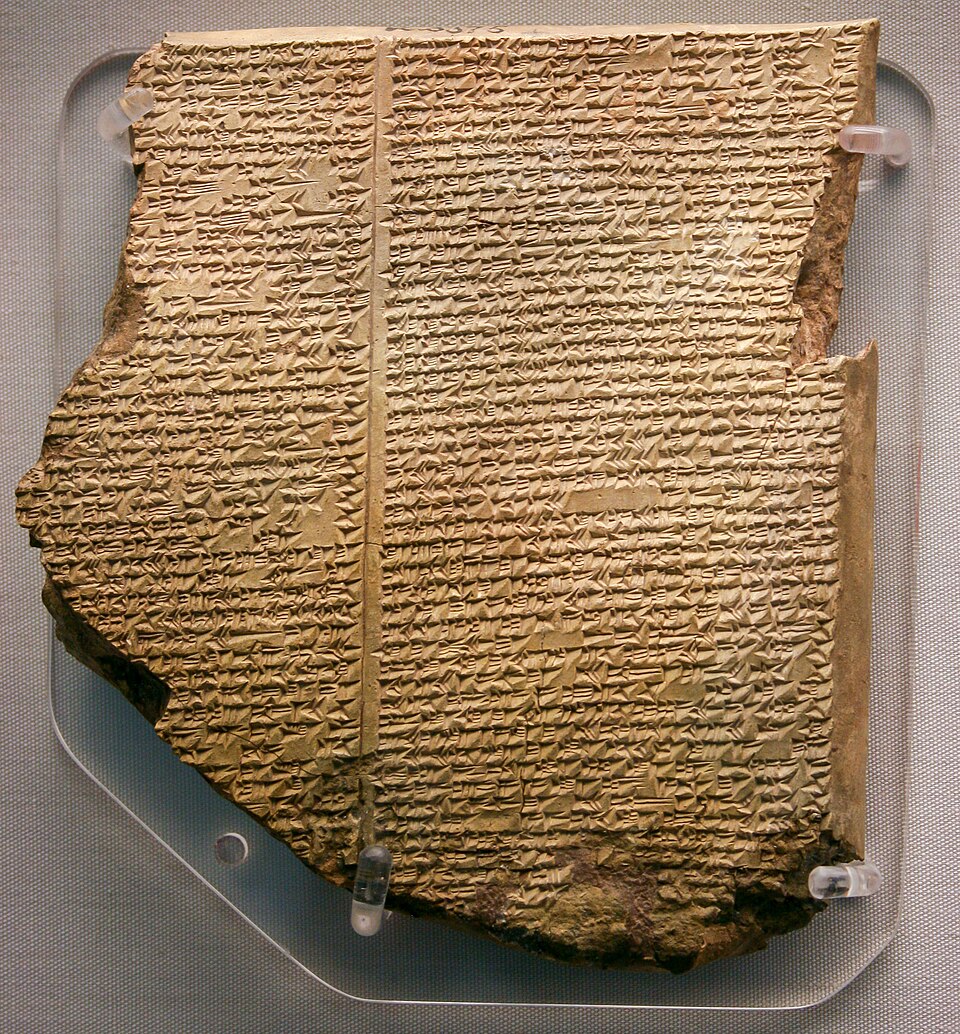
The cuneiform Flood Tablet, Epic of Gilgamesh Tablet XI, British Museum
Fig. 1 — The “Flood Tablet” (Gilgamesh XI), British Museum K.3375, from Ashurbanipal’s 7th-c. BCE library at Nineveh. George Smith read it aloud in 1872 and the modern comparison of Genesis with Mesopotamia began.Photo: Mike Peel, CC BY-SA 4.0, via Wikimedia Commons.

The Mesopotamian core — three versions of one tradition

  • The Sumerian Ziusudra is the oldest named flood hero, and he ends not with a covenant but with immortality in paradise. Debated date In the fragmentary “Eridu Genesis,” the pious king-priest Ziusudra of Shuruppak is warned by the god Enki through a reed wall, rides out a storm of seven days and seven nights, then sacrifices an ox and a sheep and is granted eternal life in Dilmun, “the place where the sun rises.” The whole thing is embedded in a larger frame about the origin of humans, animals, the five antediluvian cities, and kingship “lowered from heaven” — the flood is one beat in a creation-and-kingship epic, not a standalone story. Its single surviving witness is only a third of a tablet, so the opening and closing are lost and must be filled from Atrahasis. Thorkild Jacobsen coined the modern name “Eridu Genesis” only in 1981 (Journal of Biblical Literature 100: 513–529); the underlying age of the composition is genuinely disputed, because the one copy dates to ~1600 BCE and nothing proves the content is older than that.
  • Atrahasis supplies the motive the others lack — and it is nothing like sin. Established text In this Old Babylonian poem of ~1,200 lines the gods send the flood because humanity has multiplied and its noise (Akkadian rigmu) robs the god Enlil of sleep; plague, drought and famine are tried first, and the flood is the final escalation. Enki again warns the hero through a reed wall by the famous legal trick of addressing the wall, not the man, so as not to break his oath. Afterward the starving gods — deprived of the sacrifices humans provide — “gathered like flies” over Atrahasis’s offering, and the story resolves by inventing death, miscarriage and celibate priestesses to cap population, rather than by any blessing. This is a theodicy of overpopulation and divine resource-management, and it is the closest structural parallel to the whole Genesis primeval history (Tikva Frymer-Kensky, Biblical Archaeologist 40, 1977).
  • The Gilgamesh flood is a borrowed flashback — and it is the version that gave us the dove, the swallow and the raven. Consensus In Tablet XI the survivor Utnapishtim (Sumerian Ziusudra) tells Gilgamesh how he was spared: the storm so terrified the gods that they “cowered like dogs,” and when it ended he released a dove, then a swallow (both returned), then a raven that did not — the sign of dry land. His vessel is a perfect 120-cubit cube of six decks and nine compartments, and it grounds on Mount Nimush for seven days. Crucially, the oldest Gilgamesh tablets contain no flood at all: Jeffrey Tigay (The Evolution of the Gilgamesh Epic, 1982) showed the flood was lifted wholesale from Atrahasis into the later Standard Babylonian edition, redacted by Sin-leqi-unninni around 1200–1100 BCE. The three-bird test here is the direct literary ancestor of Genesis’s raven-and-dove.
↓ Three Mesopotamian versions share a hero, a boat, a seven-day storm, a bird test and a mountain — so the next question is what the Hebrew account keeps and what it deliberately changes. ↓
Edward Hicks, Noah's Ark, 1846
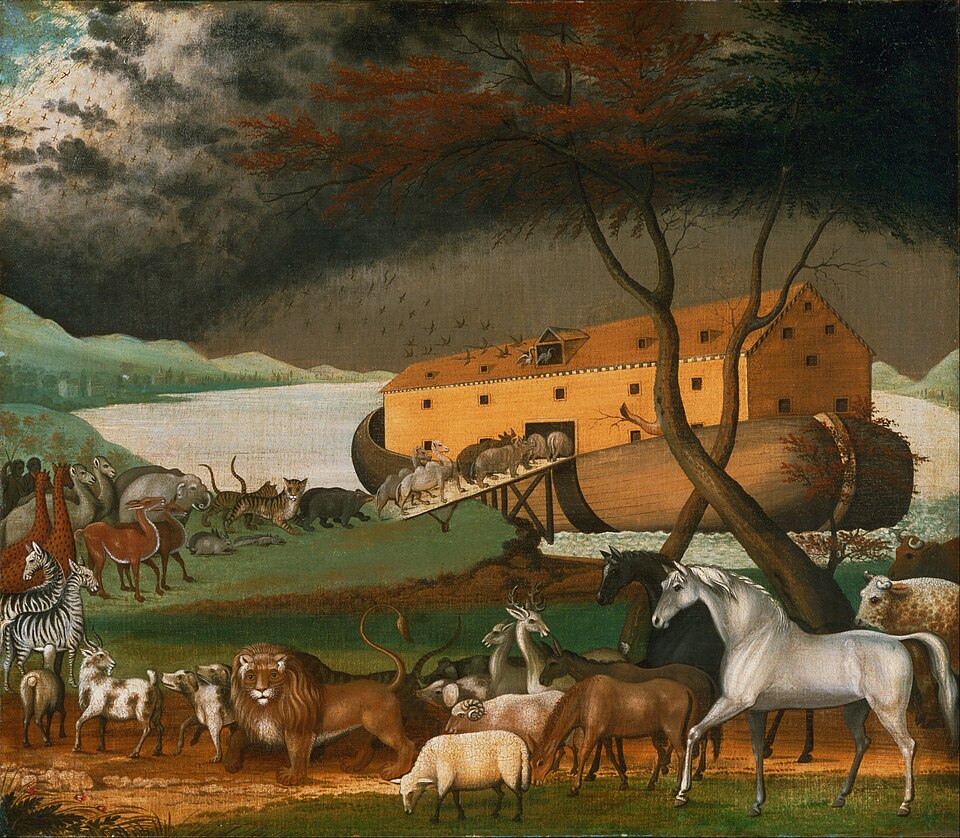
Fig. 2 — Edward Hicks, Noah’s Ark (1846). Genesis keeps the boat, the birds and the mountain of its Mesopotamian predecessors but rewrites the theology: one God, a moral cause, and a covenant sealed with a rainbow.Edward Hicks (1780–1849), public domain, via Wikimedia Commons (Google Art Project).

Hebrew and Greek

  • Genesis keeps the Mesopotamian furniture but rebuilds the house on three new foundations. Established Noah’s ark is a pitched wooden box 300 × 50 × 30 cubits (a seaworthy 6:1 barge, unlike Gilgamesh’s cube); it rains 40 days, the waters “prevail” 150 days, and the episode spans about a year by the Priestly calendar (Gen 7:11; 8:14). The three decisive changes are theological: the squabbling, frightened, hungry pantheon collapses into one sovereign God who needs nothing; the cause shifts from divine annoyance to human wickedness (“every intention… only evil continually,” Gen 6:5); and the story ends not in the hero’s immortality or in population-control but in a universal covenant with the rainbow as its permanent sign. The seven-day motif survives on both sides (Mesopotamia’s 7-day storm; Genesis’s 7-day dove intervals and seven pairs of clean animals) — one of the clearest literary fingerprints linking them. Whether Genesis 6–9 is itself a weave of two sources (J and P) or a single chiastic composition is a live scholarly dispute (Wellhausen 1883 and Westermann 1984 for the sources; Wenham, Vetus Testamentum 28, 1978, for unity).
  • The Greek Deucalion flood has no animals and no ark-full of pairs — it repopulates the earth from stones. Debated link Warned by his father Prometheus, Deucalion and his wife Pyrrha float in a chest (larnax) for nine days, ground on Mount Parnassus, sacrifice to Zeus, and are told by an oracle to throw “the bones of your mother” behind them; reading “mother” as Earth and “bones” as stones, they cast rocks that become men and women. There is no boarding of animals and no bird test; the flood is fused to Greek ethnogenesis — their son Hellen is the eponym of the Hellenes. The myth has no single ur-text: it is reconstructed from the archaic Hesiodic Catalogue of Women and Pindar’s Olympian 9 (466 BCE) up to the full Roman-era tellings of Ovid (Metamorphoses 1, c. 8 CE) and Apollodorus. Whether it descends from the Near Eastern flood or developed independently around a shared memory of flooding is genuinely unsettled (M. L. West, The East Face of Helicon, 1997, argues for Eastern influence).
↓ Everything so far is Mediterranean and interconnected — so the real test of universality is what the rest of the world says. ↓

The wider world — four independent patterns and several contaminated ones

Matsya, the fish avatar of Vishnu, towing Manu's boat
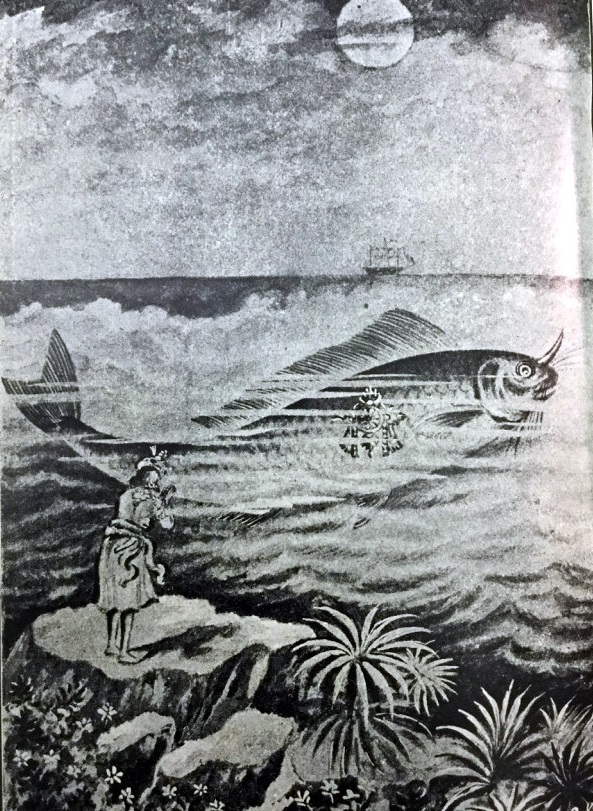
Fig. 3 — Matsya towing Manu’s boat by a rope tied to its horn. In the earliest layer (Shatapatha Brahmana, c. 800–600 BCE) the fish is an unnamed helper; only a millennium later does it become an avatar of Vishnu.Unknown artist, public domain, via Wikimedia Commons.
  • India’s Manu-and-the-fish shows a flood tradition visibly growing inside its own culture. Established The oldest Indian version, in the Shatapatha Brahmana 1.8.1 (c. 800–600 BCE), has a fish warn Manu of a deluge, be towed by a rope tied to its horn, and leave Manu alone on a northern mountain to repopulate the earth. Decisively, at this earliest stratum the fish is not yet a god; only in the Mahabharata and the later Matsya Purana (first millennium CE) is it promoted to Matsya, the first avatar of Vishnu. That internal “promotion” across datable strata is strong evidence of an indigenous tradition evolving on its own, not one imported whole. The parallels to Mesopotamia (warned survivor, boat, mountain) are real, but the tradition is securely pre-Christian and uncontaminated by missionary contact.
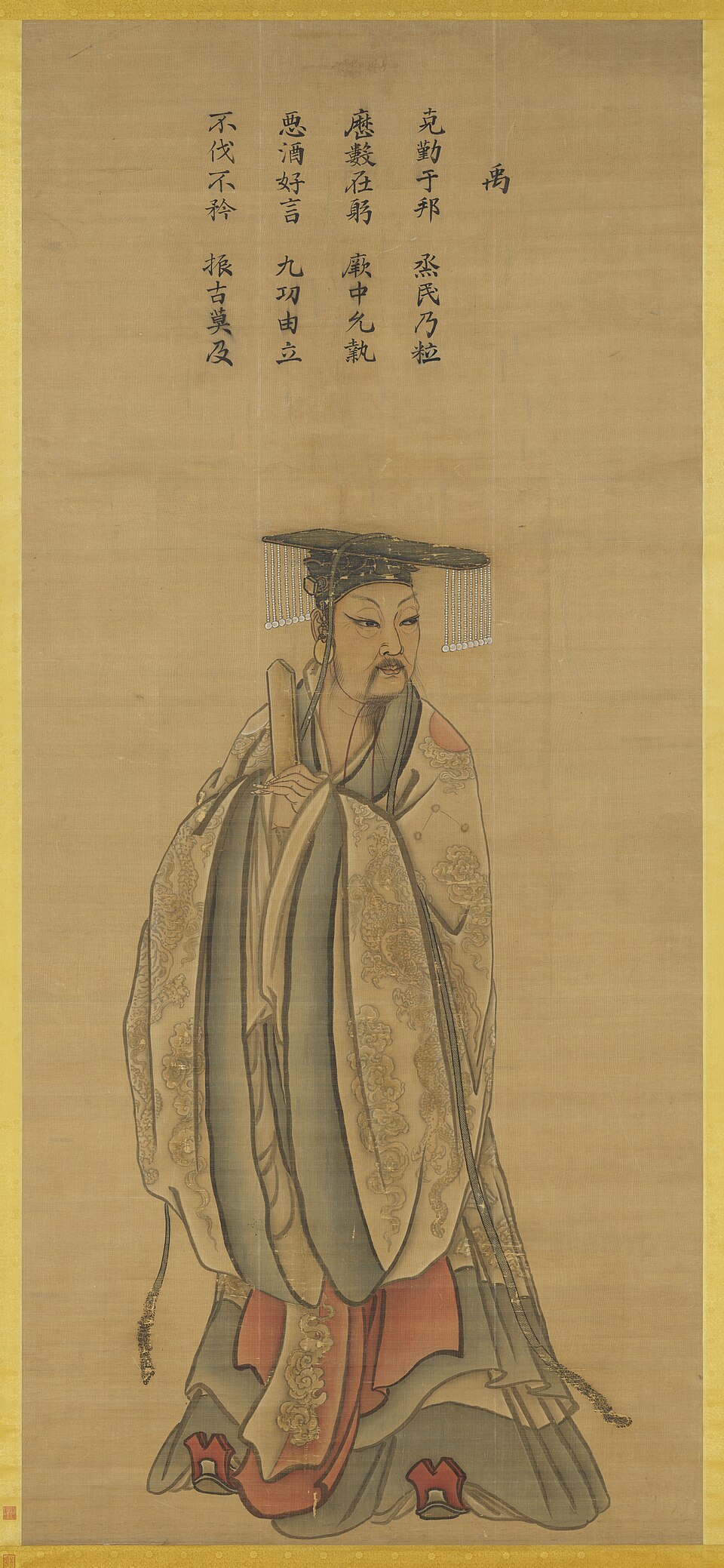
  • China’s Great Flood is the structural opposite of Noah: no ark, no family, no divine punishment — an engineer dredges the waters away. Established The waters rise over the land for a generation; Gun fails by building dikes and is executed; his son Yu the Great succeeds over thirteen years by dredging channels to the sea, and is rewarded with the throne, founding the Xia dynasty. The earliest written attestation is not a classic but a bronze vessel, the Bin Gong xu (c. 900 BCE), whose ~98 characters open with Heaven commanding Yu to clear the rivers — six centuries before the Classic of History and Mencius (4th c. BCE) record it in full. Because there is no boat to survive in and no favored remnant, this tradition cannot plausibly be a retelling of the biblical story; it is independent and embedded in Chinese dynastic ideology. (A real ~1920 BCE outburst flood on the Yellow River has been proposed as its seed by Wu et al., Science 2016, but that linkage is contested — see §3 and §8.)
  • North America’s dominant flood form rebuilds the earth from mud on a turtle’s back. Consensus In the Ojibwe/Anishinaabe “earth-diver,” after the world floods the hero Nanabozho floats on a log and sends animals diving for mud; muskrat finally surfaces half-dead with a pawful of earth, which is spread on a turtle’s back to remake the land (“Turtle Island”). There is no ark, no punished sin, no patriarch — the emphasis is cooperative re-creation, and the same pattern recurs across dozens of North American and Siberian peoples (Alan Dundes, “Earth-Diver,” American Anthropologist 64, 1962). Its non-biblical structure argues for genuinely independent origin, even though every written version postdates 19th-century ethnography (Schoolcraft, Algic Researches, 1839) and sustained European contact. Individual retellings recorded after missionization sometimes acquire biblical coloring, so each must be weighed on its own.
  • The Norse “flood” is a flood of blood, and it drowns giants, not sinners. Established When Odin and his brothers kill the primeval giant Ymir, so much blood pours out that it drowns the frost-giants — all but Bergelmir, who escapes with his wife on a lúðr (a hollowed log or mill-chest); the world is then built from Ymir’s body. It is recorded in Snorri Sturluson’s Prose Edda (c. 1220) and the Poetic Edda (Codex Regius, c. 1270), by Christian Icelanders two centuries after conversion — yet the content is so conspicuously pagan and un-biblical (a cosmogonic dismemberment, not a moral deluge) that scholars treat it as independent Germanic myth. It is a useful reminder that “a survivor escapes rising waters in a vessel” is a thin enough motif to arise more than once.
King Yu of Xia, who tamed the Great Flood of China
Fig. 4 — Yu the Great, who (in the Chinese tradition) ended the flood not by riding it out but by dredging the rivers to the sea over thirteen years — a hydraulic-engineering epic with no ark and no remnant family.Attributed to Ma Lin (13th c.), public domain, via Wikimedia Commons.
  • The New World and Pacific “flood legends” are the ones to handle with the most suspicion — many are retold Genesis. Contamination risk The Aztec couple Tata and Nene survive the end of the “Fourth Sun” in a hollow log, but the texts (Codex Chimalpopoca, 1558; Codex Ríos, c. 1570s) were written decades after 1521 by or for Spanish clergy. The Maya drowning of the “wooden people” (Popol Vuh) has a stronger pre-contact anchor because flood imagery appears on the genuinely pre-Columbian Dresden Codex — but the surviving manuscript is Friar Ximénez’s c. 1701 copy. The Hawaiian “Nu‘u,” who rides a flood in an “ark” with his family and lands atop Mauna Kea, is the textbook case: Martha Beckwith (Hawaiian Mythology, 1940) noted the story “shows a decided tendency to strain after biblical analogy,” and it was collected after intensive Protestant missions began in 1820. The honest rule: a tale with an ark, a righteous warned survivor and released birds, recorded post-mission, is presumed borrowed unless a pre-contact attestation exists.
  • The single most awkward fact for “every culture has a flood” is that humanity’s oldest homeland mostly does not. Consensus James Frazer’s classic survey (Folk-Lore in the Old Testament, vol. 1, 1918) already noted the striking scarcity of native flood traditions across much of sub-Saharan Africa, and later folklorists have repeatedly confirmed the gap. The African examples usually cited — the Maasai “Tumbainot” (a righteous man, an ark, animals, doves) recorded by Hollis in 1905, or the Kwaya tale collected by 20th-century missionaries — are so Noah-like that contamination is the default assumption. If one global flood had seeded a true universal memory, that memory should be strongest, not weakest, in the continent where our species has lived longest. The distribution instead points to recurring local flood experience plus some ancient diffusion. (Australia’s coastal stories, by contrast, may encode a real local event — see §7.)
Table 1 — The twelve flood traditions compared. “Vessel,” “cause” and “end” are the load-bearing differences; where they diverge sharply from Noah, independent origin is more likely.
TraditionHero / survivorVesselCauseEndingIndependence
SumerianZiusudraGreat boatDivine decreeImmortality in DilmunCore tradition
Babylonian (Atrahasis)AtrahasisBoat, pitchedHuman noisePopulation controlsCore tradition
Babylonian (Gilgamesh XI)Utnapishtim120-cubit cubeDivine decreeImmortality; dove/ravenCore tradition
Hebrew (Genesis)Noah300×50×30 boxHuman wickednessCovenant + rainbowReshapes the core
GreekDeucalion & PyrrhaChest (larnax)Human impietyPeople from stonesDebated
HinduManuBoat towed by fishCyclical dissolutionManu repopulatesPre-Christian; indep./diffused
ChineseYu the GreatNone — dredging(Flood to be tamed)Founds Xia dynastyIndependent
AztecTata & NeneHollow logEnd of the Fourth SunTurned into dogsMixed / post-contact
N. AmericanNanabozhoLog + diving animalsWorld-floodEarth rebuilt on turtleIndependent (earth-diver)
AndeanCañari brothersMountain that growsViracocha’s judgmentMacaw-brides, new peopleMixed / post-contact
NorseBergelmirHollow log / mill-chestYmir slain (blood-flood)Giants re-descendIndependent
Hawaiian / BatakNu‘u / (Batak)“Ark” / mountainDivine / serpent shiftLands on a peakNu‘u contaminated; Batak indep.

In one breath: a dozen cultures tell of a destroying flood, but once you read them closely they fall into a Mesopotamian family (into which Genesis and perhaps Deucalion belong), a set of structurally different independents (China, the Norse, the earth-divers), one pre-Christian Indian cousin, and a thick layer of New-World and Pacific tales recorded too late, by the wrong hands, to count as independent witnesses.

§2Dating & Paleography — Story vs. Oldest Copy— exactly when each tradition was composed, and the date of the earliest surviving physical manuscript of each.

The question “how old is the flood story?” has two completely different answers, and conflating them is the single commonest error in popular treatments. One is the date the story was composed; the other is the date of the oldest surviving physical copy — the tablet you can hold or the manuscript you can carbon-date. Paleography (dating by the style of the script) and archaeology date the artifact, not the composition. A story can be far older than its oldest copy (oral transmission), or a copy can be the only evidence we have that the story is that old at all. Table 2 keeps the two columns rigorously apart.
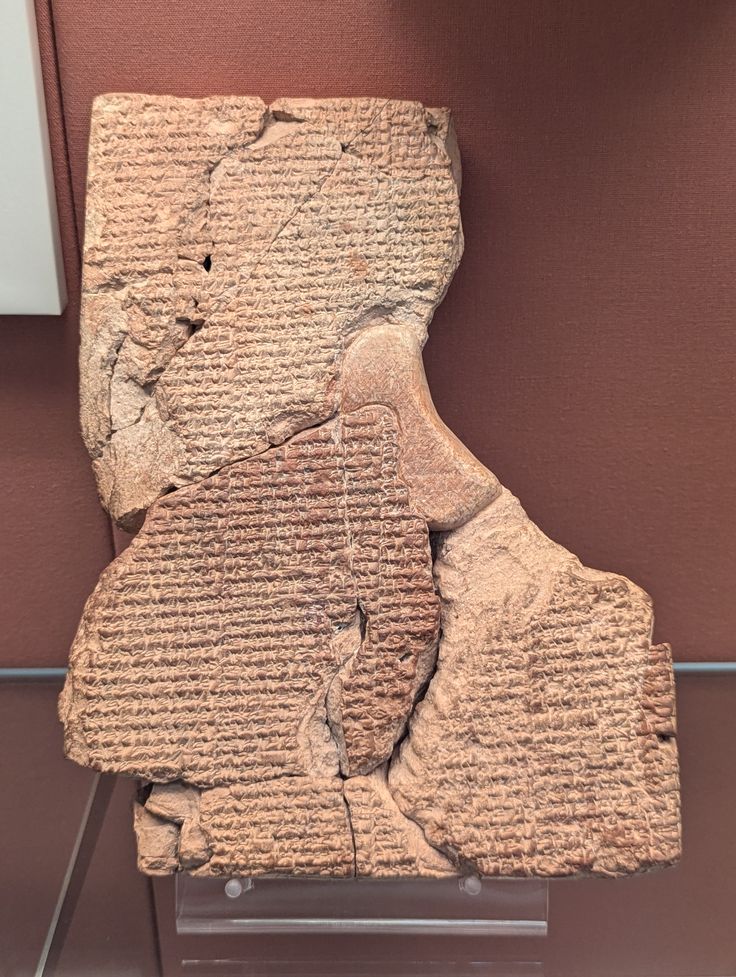
Old Babylonian Atrahasis flood tablet, British Museum
Fig. 5 — An Old Babylonian tablet of the Atrahasis flood epic (British Museum). The standard recension carries a scribal colophon dating the copy to the reign of Ammi-ṣaduqa (c. 1646–1626 BCE) — one of the firmest absolute dates for any flood text, because it is written on the object.Photo: SpeakingArch, CC BY-SA 4.0, via Wikimedia Commons.
The firmest date in the whole corpus is a scribe’s signature, not a scholar’s estimate. Established The standard Old Babylonian Atrahasis was copied by a junior scribe (read as Ku-Aya or Nūr-Aya) who dated his own colophon to the reign of Ammi-ṣaduqa, c. 1646–1626 BCE. Because that is an internal dated statement rather than a paleographic guess, it anchors the Mesopotamian flood literature to roughly 1630 BCE as a hard floor — a full millennium before any plausible date for the writing of Genesis. The poem itself is Old Babylonian and perhaps slightly older than this particular copy, but not demonstrably by much. Lambert & Millard, Atra-ḫasīs: The Babylonian Story of the Flood (Oxford, 1969).
The oldest physical copy of the Gilgamesh flood is a 7th-century BCE library tablet — and the oldest Gilgamesh tablets contain no flood at all. Established The famous “Flood Tablet,” British Museum K.3375, came from the royal library of Ashurbanipal at Nineveh and dates to the 7th century BCE, even though the tradition it transmits (via Atrahasis) is a thousand years older. The self-taught George Smith read it to the Society of Biblical Archaeology on 3 December 1872, and a pre-biblical flood with a bird-test and a mountain landing became a sensation overnight. Decisively, the older Old Babylonian Gilgamesh tablets lack the flood episode entirely — it was inserted into the later Standard Babylonian edition, proving the flood was imported into the epic rather than original to it. A. R. George, The Babylonian Gilgamesh Epic (Oxford, 2003); Smith, “The Chaldean Account of the Deluge” (1873).
For Genesis, the earliest complete Hebrew text of the flood is as late as 1008 CE — because the older master copy lost its Torah. Established one detail unverified The oldest fragmentary witnesses are at Qumran: the Dead Sea Scrolls include Genesis manuscripts of the 2nd c. BCE–1st c. CE, and a dedicated flood commentary, 4Q252 (late 1st c. BCE), works out the flood calendar in detail. But the earliest surviving complete Hebrew text of Genesis 6–9 is the Leningrad Codex, 1008/1009 CE, because the older Aleppo Codex (c. 930 CE) lost almost its entire Torah after the 1947 riots. The Greek Septuagint supplies an older translation witness in Codex Alexandrinus (5th c. CE), since Codex Vaticanus has a lacuna covering Genesis 1:1–46:28. Honesty flag: whether any strictly biblical 4QGen scroll substantially preserves the flood chapters themselves is uncertain; the dependable Qumran flood witness is the commentary 4Q252, not a continuous biblical scroll of chapters 6–9. Standard critical editions (BHS/BHQ); Tov, Textual Criticism of the Hebrew Bible; Qumran catalogue (4Q252).
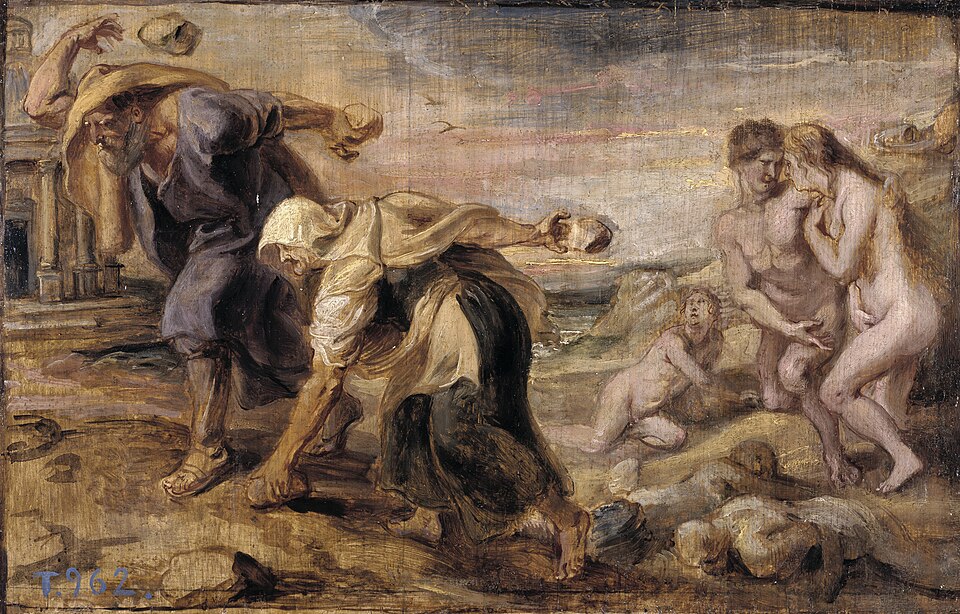
Rubens, Deucalion and Pyrrha, 1636
Fig. 6 — Rubens, Deucalion and Pyrrha (1636). The Greek flood has no excavated “original”: its dates attach to authors (Pindar 466 BCE; Ovid c. 8 CE) whose works survive only through much later medieval manuscript copies — a wholly different evidentiary situation from the cuneiform tablets, which are physical originals.Peter Paul Rubens (1636), public domain, via Wikimedia Commons.
Table 2 — Composition date vs. oldest surviving physical copy. The two are routinely conflated; they are not the same evidence.
TraditionStory composed (scholarly range)Oldest surviving physical copyDating basis
Sumerian (Ziusudra)OB period; older debatedCBS 10673, ~1600 BCEOB Sumerian script; Nippur 1893; pub. Poebel 1914
AtrahasisOld Babylonian, ~18th–17th c. BCECopy c. 1646–1626 BCEDated colophon (reign of Ammi-ṣaduqa)
“Ark Tablet” (Atrahasis variant)Old Babylonian~1900–1700 BCEScript (Finkel 2014); round-coracle ark
Gilgamesh XISB redaction ~1200–1100 BCEK.3375, 7th c. BCENeo-Assyrian script + Nineveh library context
Hebrew (Genesis 6–9)J/P ~10th–6th c.; final redaction 6th–5th c. BCEFrag.: DSS 4Q252, late 1st c. BCE · Complete: Leningrad Codex, 1008 CEPaleography (DSS); dated colophon (Leningrad)
Greek (Deucalion)Allusions 7th–6th c. BCE (Hesiod, Pindar 466 BCE)No tablet; via medieval MSS of Ovid (c. 8 CE), ApollodorusAuthor-dating; later manuscript transmission
Hindu (Manu)Shatapatha Brahmana, c. 800–600 BCEMuch later palm-leaf MSSLinguistic dating of the text layer
Chinese (Yu)Classic of History / Mencius, 4th c. BCEBin Gong xu bronze, c. 900 BCEBronze epigraphy (inscription)
Norse (Bergelmir)Pre-Christian oral; recorded 13th c.Prose Edda c. 1220; Codex Regius c. 1270Manuscript dating
N. American (earth-diver)Pre-contact oralSchoolcraft, 1839Date of first ethnographic transcription
Mesoamerican (Aztec / Maya)Pre-Columbian motif; colonial textCodex Chimalpopoca 1558; Popol Vuh (Ximénez) c. 1701Colonial manuscript dating
↓ So the written record runs from ~1900 BCE cuneiform to medieval manuscripts — all of it long after the Ice Age. That forces the real question: were there ever floods big enough to seed these memories? ↓

In one breath: the oldest flood document is a ~1900–1700 BCE Babylonian tablet; the oldest copy of the Gilgamesh flood is 7th-century BCE; the oldest complete Hebrew flood text is 1008 CE; and the Greek, Chinese, Norse and New-World versions are later still or survive only through copies — so every flood story on Earth was written down thousands of years after the last great natural floods actually happened.

§3Real Megafloods Written in the Rock— the Missoula floods, the Zanclean deluge, Black Sea, Agassiz, Storegga, and the great post-glacial drowning — how each truly happened.

Here is the part that surprises people on both sides of the argument: the Earth’s crust really does carry the scars of enormous, sudden floods — walls of water that dwarf anything in recorded history. Geology spent a century resisting that idea and then had to accept it. The catch, which the rest of this document builds on, is that every one of these megafloods is regional, separately dated, and caused by a specific mechanism (a bursting ice dam, a basin refilling, a collapsing shelf). They are spread across 5.3 million years. Their collective lesson is methodological — catastrophic magnitudes are real and detectable — not that one worldwide inundation occurred.
Framing — neocatastrophism Geology had to learn that rare, violent events are scientific. Charles Lyell’s Principles of Geology (1830–33) made strict gradualism the rule, and for decades “catastrophe” sounded like a relapse into pre-scientific thinking — which is exactly why J Harlen Bretz’s giant-flood hypothesis was rejected for ~40 years on principle rather than on the field evidence. Derek Ager’s The Nature of the Stratigraphical Record (1973) reframed Earth history as “long periods of boredom and short periods of terror,” and the Alvarez impact paper (1980) forced the discipline to accept that a single instantaneous event could reset the biosphere. The modern position is actualism: the same physical laws operated, including rare high-energy events, and their rates are read from the rock — not assumed. Accepting local megafloods is the opposite of endorsing one global flood.
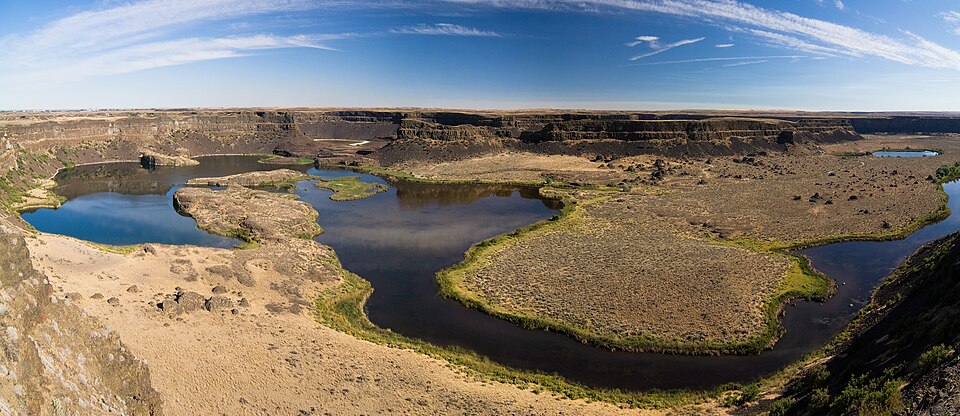
Dry Falls, Washington — a dry cataract carved by the Missoula floods
Fig. 7 — Dry Falls, Washington: a ~5.6 km-wide, ~120 m-high dry cataract — far larger than Niagara — cut by the Missoula megafloods and left high and dry when they stopped.Photo: Ikiwaner, CC BY-SA 3.0, via Wikimedia Commons.
The Missoula floods are the textbook megaflood — and the story of how science got them wrong for 40 years. Established A lobe of the Cordilleran Ice Sheet dammed the Clark Fork River, ponding Glacial Lake Missoula (up to ~2,184 km³, about Lakes Erie and Ontario combined); when the water floated and failed the ice dam it drained in a day or two, and the cycle repeated. J Harlen Bretz proposed a colossal flood for the Channeled Scabland in 1923 (Journal of Geology 31:617–649) and was rejected for decades until Pardee (1942) supplied the lake source and the giant current ripples. O’Connor & Baker (1992, GSA Bulletin 104) reconstructed a peak discharge of ~17 ± 3 million m³/s near the breakout — roughly a thousand times the Mississippi. Bretz 1923 J. Geol.; Pardee 1942 GSA Bull. 53; O’Connor & Baker 1992 GSA Bull. 104.
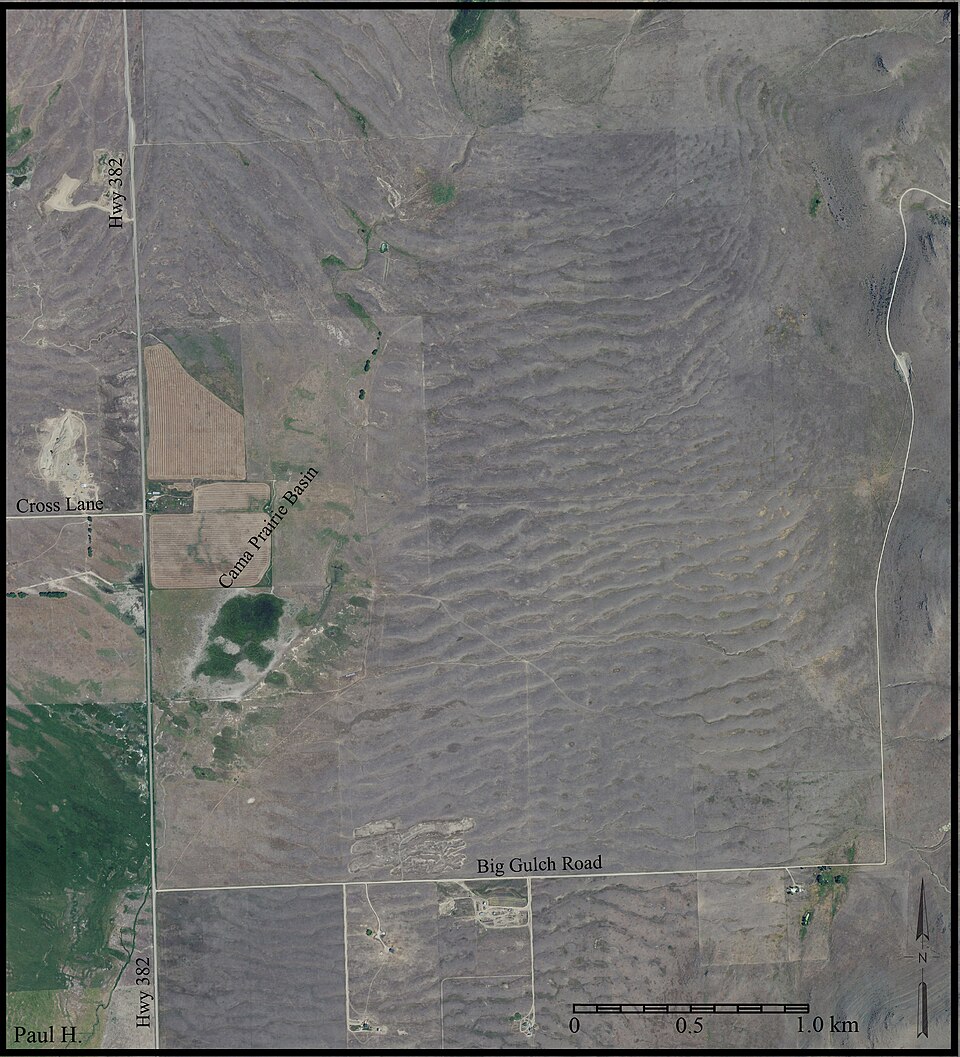
Giant current ripples, Camas Prairie, Montana
Fig. 8 — Giant current ripples on the floor of Camas Prairie, Montana — gravel bedforms up to ~15 m high and ~150 m apart. They are ordinary river ripples scaled up thousands of times, and they proved deep, fast flow.Photo: Paul H., CC BY 4.0, via Wikimedia Commons.
There was not one Missoula flood but about forty, each counted as a graded layer. Established Richard Waitt (1985, GSA Bulletin 96:1271–1286) counted more than 40 rhythmites in back-flooded slackwater valleys (the Touchet Beds), each a sand-to-silt couplet recording one flood followed by quiet settling, corroborated by varve counts between flood beds. The series spans roughly 18,000–15,000 years ago, pinned by radiocarbon and by the Mount St. Helens set-S tephra interbedded in the deposits. The diagnostic signature set — scoured basalt coulees, Dry Falls, ice-rafted erratics stranded high on slopes, giant gravel bars, graded slackwater rhythmites — is now textbook, and after the 1965 field excursion a famous telegram to Bretz read “we are all now catastrophists.” He received the Geological Society of America’s highest award in 1979. Waitt 1985 GSA Bull. 96; Baker, GSA Special Paper 144 (1973).
Satellite view of the Strait of Gibraltar
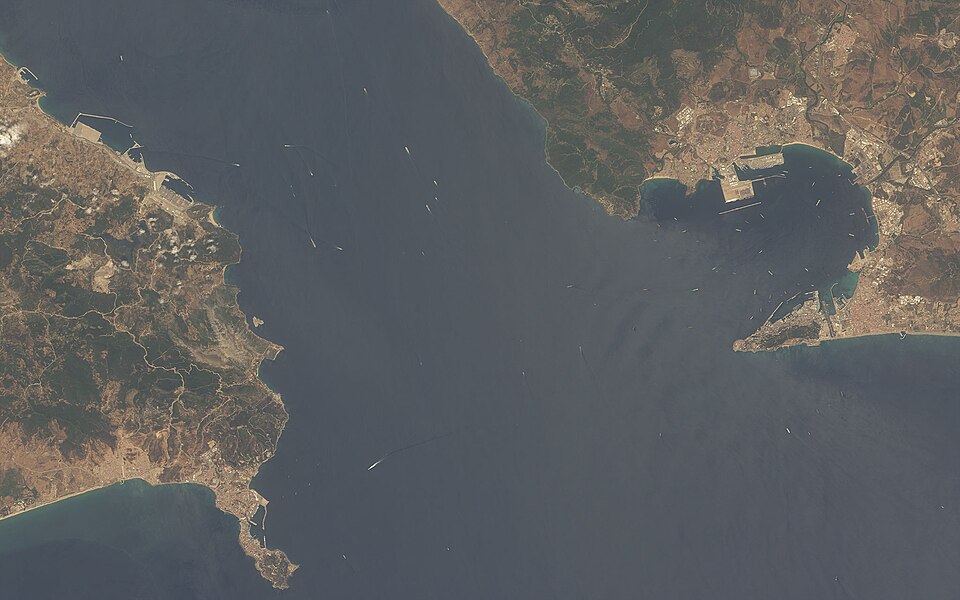
Fig. 9 — The Strait of Gibraltar from orbit. ~5.33 million years ago Atlantic water cut back through this threshold and refilled a desiccated Mediterranean at ~10⁴ m³/s, raising basin level more than 10 m per day.Imagery: Axelspace Corporation, CC BY-SA 4.0, via Wikimedia Commons.
The Zanclean flood refilled an entire dry sea in months, at a thousand times the Amazon. Established Between ~5.97 and 5.33 Ma the Mediterranean was cut off and largely evaporated (the Messinian Salinity Crisis), leaving kilometre-thick salt. The Zanclean flood ended it: Atlantic water eroded through the Gibraltar threshold into basins up to ~1,500 m deep. García-Castellanos et al. (2009, Nature 462:778–781) modelled a peak discharge on the order of 10⁴ m³/s (~100 million m³/s), with the basin filling to ~90% within a few months to ~2 years and water level rising more than 10 m per day at the climax. The fingerprint is a buried erosion channel ~200 km long and >250 m deep traced through the Strait — and the event defines the Miocene–Pliocene boundary at 5.33 Ma. García-Castellanos et al. 2009 Nature 462; Hsü et al. 1973 Nature (MSC discovery).
The “Black Sea deluge” — once marketed as the real Noah’s flood — is the one genuinely contested case, and it has been deflated. Contested Ryan, Pitman & colleagues proposed (1997, Marine Geology 138:119–126; popularized in Noah’s Flood, 1998) that ~7,600 years ago a rising Mediterranean breached the Bosporus and catastrophically drowned a low freshwater Black Sea lake. But Aksu et al. (2002, GSA Today 12) documented persistent Holocene outflow from the Black Sea — the opposite of a one-way inrush — and Giosan et al. (2009, Quaternary Science Reviews 28) put the pre-reconnection level only ~30 m low and the rise at a gentle ~5–10 m, drowning perhaps ~2,000 km² rather than ~70,000. A marine reconnection certainly happened; the deep, sudden, deluge version is a minority reading. This is the honest counter-example to any “science found Noah’s flood” headline. Ryan et al. 1997 Mar. Geol. 138; Aksu et al. 2002 GSA Today 12; Giosan et al. 2009 QSR 28.
Map of Doggerland, the drowned North Sea plain, c. 10,000 BP
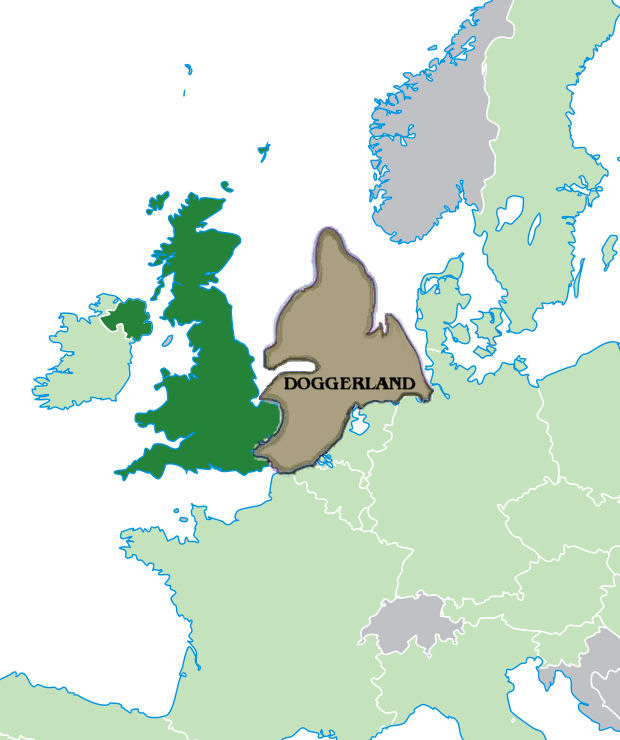
Fig. 10 — Doggerland (c. 10,000 BP): the inhabited plain that joined Britain to Europe, progressively drowned by post-glacial sea-level rise and finally struck by the Storegga tsunami ~8,150 years ago.Map: Polaris999 (after Quizimodo), public domain, via Wikimedia Commons.
The real, human-witnessed “great flood” was the slow drowning of the continental shelves — about 120 metres of sea-level rise. Established As the Last Glacial Maximum ice sheets melted, global sea level rose roughly 120–134 m between ~21 ka and ~7 ka (Lambeck et al. 2014, PNAS 111:15296–15303), with a sharp surge — Meltwater Pulse 1A — of ~14–18 m in a few centuries ~14,600 years ago (Deschamps et al. 2012, Nature 483; first seen in drowned Barbados reefs, Fairbanks 1989, Nature 342). Whole inhabited landmasses vanished: Doggerland (North Sea), Sundaland (SE Asia), the Persian Gulf basin, and Beringia. This is a eustatic rise over centuries, regionally catastrophic for coastlines — not an hours-scale wall of water, and never a synchronous worldwide deluge. On top of it, the Storegga submarine landslide (~8,150 cal BP; ~2,400–3,200 km³ of sediment) launched a North Sea tsunami with ~20 m run-up in Shetland, finishing Doggerland off. Lambeck et al. 2014 PNAS 111; Deschamps et al. 2012 Nature 483; Weninger et al. 2008 (Storegga); Clark et al. 2009 Science 325 (LGM).
Table 3 — The real megafloods of the geological record. Different dates, different mechanisms, spread over 5.3 million years — the opposite of one synchronous event.
EventDateMechanismHeadline magnitudeSignatureStatus
Missoula floods~18–15 ka (~40×)Ice-dam jökulhlaups~17±3×10⁶ m³/sScabland, Dry Falls, ripplesEstablished
Zanclean megaflood~5.33 MaGibraltar basin refill~10⁴ m³/s; >10 m/day200 km buried channelEstablished
Black Sea “deluge”~7.6 ka (proposed)Bosporus breach~5–10 m (disputed)Submerged shorelineContested
Lake Agassiz / 8.2 ka~8.4 kaLaurentide dam collapse~163,000 km³ freshwaterDeep-sea red-bed; strandlinesMainstream, debated
Storegga slide~8,150 cal BPSubmarine landslide tsunami~20 m run-upTsunami sand in peatEstablished
Altai megafloodsLate PleistoceneIce-dam jökulhlaups~10⁶–10⁷ m³/sGiant gravel dunes (~16 m)Established
MWP-1A / deglacial rise~14.6 ka; LGM–presentIce-sheet collapse / eustatic~14–18 m; ~134 m totalDrowned reefs; submerged shelvesEstablished
↓ So titanic floods are real — but they are many, local, and scattered across millions of years. Could any single one of them have made the layered, fossil-bearing rock itself? ↓

In one breath: the rocks record genuine megafloods bigger than any in human history — Missoula at seventeen million cubic metres a second, the Mediterranean refilling in months, 120 metres of sea drowning Doggerland — but they are a scattered archive of distinct, dated, regional catastrophes, which is precisely why they cannot be collapsed into one worldwide year-long flood.

§4How the Layers & Fossils Actually Form— Steno to radiometric dating; why reefs, salt beds, soils, unconformities and varves demand deep time, not one year.

If titanic floods are real, the natural next thought is: maybe one of them made all the layers. This section explains why that cannot be — not by asserting deep time, but by showing how the rocks are actually built. The decisive fact a one-year flood must defeat is not one clever stratum but the mutual agreement of a dozen independent clocks — biological, chemical, radiometric, astronomical — discovered by different people for different reasons across three centuries, all returning the same ordering and the same magnitudes.
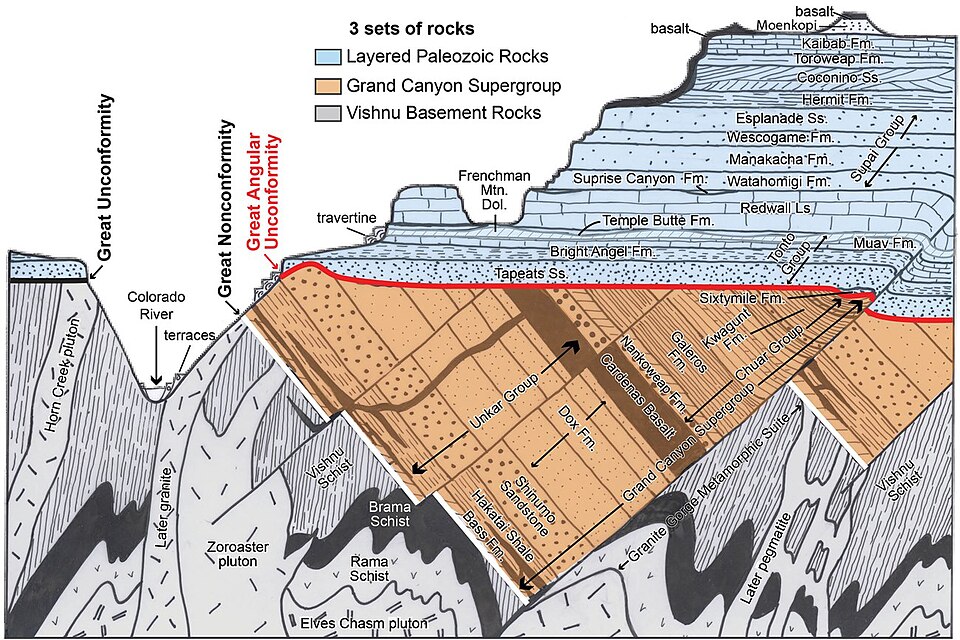
Stratigraphic column of the Grand Canyon
Fig. 11 — The Grand Canyon column. No single outcrop on Earth shows the whole record; it is stitched together from overlapping sections tied by index fossils — and the fossil order never reverses from basin to basin.U.S. National Park Service (2021), public domain, via Wikimedia Commons.

Part A — How deep time was actually established

  • Stratigraphy began as pure observation, not as a theory about age. Established Nicolas Steno, dissecting a shark in 1669, reasoned that a solid enclosed in rock was deposited before the rock around it, and derived four rules still used at every outcrop: superposition (lower is older), original horizontality, lateral continuity, and cross-cutting (a fault is younger than what it cuts). These are not age assumptions; they are reading rules, and they already implied that rock records a sequence of events. A century later James Hutton saw that mountains erode to sediment, sediment lithifies, rock uplifts and erodes again — a cycle so slow he found “no vestige of a beginning,” and his friend Playfair, standing at Siccar Point, felt “the mind seemed to grow giddy by looking so far into the abyss of time.” None of this depended on evolution or on radioactivity, neither of which was yet known.
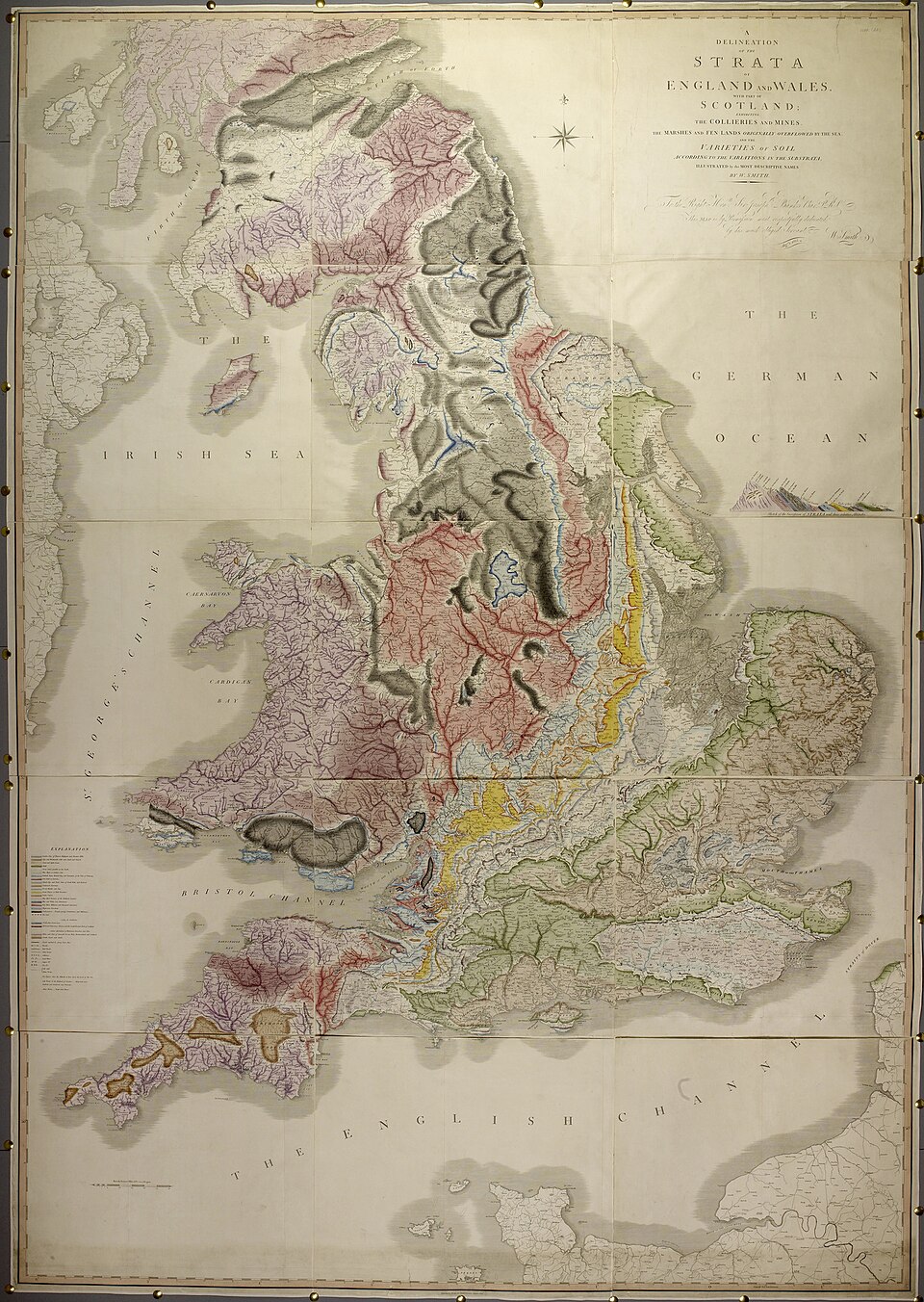
  • Fossils were proven to succeed one another in a fixed order 44 years before Darwin — by a canal surveyor who used it to predict. Established William Smith noticed each stratum carried a characteristic fossil assemblage whose order never reversed between sites, letting him forecast which rock lay beneath a field, and in 1815 he published the first geological map of a nation. His principle of faunal succession is purely empirical: it owes nothing to any theory of why the order holds and everything to the brute fact that it does. This is the single hardest fact for flood geology, because the global column is correlated by rapidly-evolving index fossils (graptolites, ammonites, foraminifera) that are found on multiple continents in the same relative position and never out of order. A mechanism that sorts corpses by density in one flood year cannot reproduce an ecological-evolutionary order that is identical across basins which never shared an environment.
  • The absolute ages come from radiometric clocks that check themselves — and then agree with clocks that use no radioactivity at all. Established Uranium–lead dating of zircon runs two independent decay chains at once (²³⁸U→²⁰⁶Pb at 4.47 Gyr; ²³⁵U→²⁰⁷Pb at 0.70 Gyr); when both give the same “concordant” age the result is validated by two nuclear clocks in one crystal. The Earth’s age, 4.54 ± 0.05 Gyr, came from lead isochrons on meteorites (Patterson 1956) and has been confirmed thousands of times since. Crucially, these ages are cross-checked against astronomical (Milankovitch) tuning, ice-core annual layers (>100,000 counted in Greenland), tree-rings (>12,000 continuous years) and lake varves — four unrelated physical systems that agree to within ~1%. Four independent phenomena converging is not a coincidence a young model can wave away.
Hutton's Unconformity at Siccar Point
Fig. 12 — Hutton’s Unconformity, Siccar Point: gently-dipping sandstone lies across the eroded, upturned edges of near-vertical older rock. Reading it requires five slow steps that cannot overlap — deposit, harden, tilt, erode flat, re-deposit.Photo: Lisa Jarvis, CC BY-SA 2.0, via Wikimedia Commons (geograph.org.uk).

Part B — How specific rocks form, and the time each one demands

  • Coal is a fossil forest-soil, proven by the roots still under every seam. Established Nearly every coal seam rests on an underclay penetrated by Stigmaria — lycopsid rootstocks in growth position, rootlets radiating down — the signature of a soil that supported a living forest before burial, not of debris rafted in by a flood. Peat compacts to coal roughly 10:1, so a 3 m seam represents ~30 m of accumulated peat (centuries to millennia), and the Appalachian Pennsylvanian stacks dozens of such seams (“cyclothems”), each with its own rooted underclay and marine roof — repeated cycles of forest growth, drowning and renewal that one flood year cannot choreograph. The classic Joggins cliffs of Nova Scotia contain upright trees at 60+ separate horizons through a 1,425 m section — not one drowned forest, but dozens stacked in series.
  • You cannot drown the world and evaporate two kilometres of salt in the same year — yet both are in the record. Established Evaporites form only by removing water, concentrating brine until salts precipitate in a fixed order (carbonate → gypsum → halite → bitterns). When the Mediterranean was cut off ~5.96–5.33 Ma it left the “salt giant”: over 2 km of halite on the basin floor (Hsü et al. 1973; Krijgsman et al. 1999). The Permian Zechstein of NW Europe stacks several complete evaporite cycles, each a full basin desiccation separated by marine re-flooding. A single freshwater flood is the chemical antithesis of a salt giant — these cannot coexist in one year by any mechanism.
  • Some formations are literally counted calendars — hundreds of thousands of annual layers, correlated basin-wide. Established The Permian Castile Formation of west Texas is calcite–anhydrite couplets, each a summer plankton-bloom lamina capped by a winter lamina; Anderson et al. (1972, GSA Bulletin) counted them individually and reached roughly 260,000 couplets over ~175,000–200,000 years, with thicknesses that correlate across the whole basin for tens of kilometres — the hallmark of a basin-wide annual signal. The Eocene Green River Formation holds couplets running into the millions over ~6 million years, together with freshwater fish, bird tracks and lake-margin soils. A flood model must form 260,000 paired, bloom-bearing, basin-correlated layers in under a year — about 700 per day — which is not a rate problem but an impossibility.
  • Reefs and fossil soils had to be where they are — they cannot be transported. Established The Permian Capitan Reef (El Capitan, Texas) is a fossil barrier reef with its sponge–algal–bryozoan framework still in growth orientation, lagoon facies behind and talus in front — a complete, zoned, in-place ecosystem hundreds of metres high, and framework reefs grow only millimetres to a few metres per thousand years. Likewise, paleosols — fossil soils identified by root traces, soil structure and calcrete nodules — form only by prolonged exposure to air, rain and roots; a mature calcrete alone needs thousands of years of stable land surface, and the column contains thousands of them stacked between marine beds. Each marks an interval when that spot was dry land with a weathering climate, which continuous year-long submergence cannot produce.
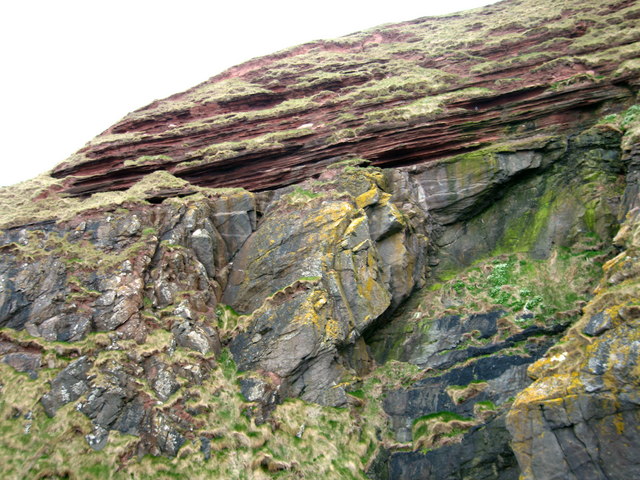
  • Angular unconformities and living surfaces encode steps that logically cannot overlap. Established At Siccar Point (Fig. 12) the record demands, in strict order: deposit the lower beds on a sea floor, lithify them, tilt them to near-vertical, uplift and erode them flat, then subside and deposit a whole new package on top — and rock must harden before it can be tilted and bevelled, and erosion must finish before new deposition begins. Add the churned burrows (bioturbation) that need animals colonising a stable floor over time, and the dinosaur nesting grounds with eggs in situ (Maiasaura at Egg Mountain; the Auca Mahuevo titanosaur egg beds) that record breeding colonies returned to over multiple seasons. These are serial by logic, not merely slow — so a single ~370-day flood is not a rate problem but a contradiction: a forest must grow before the next one buries it.
William Smith's 1815 geological map of Britain
Fig. 13 — William Smith’s 1815 map — the first geological map of a nation, built on faunal succession alone. Its predictive success, 44 years before Darwin, is the empirical bedrock of stratigraphy.William Smith (1815), CC0, via Wikimedia Commons (British Library).
↓ The rocks demand deep time on a dozen independent counts — so what does the best young-earth “flood geology” actually argue, and does any of it survive? ↓

In one breath: coal needs rooted forests, chalk needs a slow rain of plankton, salt giants need evaporation not flooding, Castile needs a quarter-million counted years, reefs and soils and unconformities each encode serial steps that cannot overlap — and radiometric, orbital, ice-core and tree-ring clocks all agree — so the layered record is deep time, not one year of water.

§5An Honest Audit of “Flood Geology”— the young-earth case steel-manned, then weighed point-by-point against the physical evidence.

Intellectual honesty cuts both ways: before weighing young-earth “flood geology,” it must be stated at its strongest, not knocked down as a caricature. Modern flood geology began with a serious book — Whitcomb & Morris, The Genesis Flood (1961) — and has developed researchable claims through Steven Austin, Andrew Snelling, and the RATE radioisotope project. Several of its observations are real and worth knowing. What follows gives its best arguments a fair hearing, then weighs each against the physical evidence.

The case, steel-manned

  • Mount St. Helens showed that fine stratification can form catastrophically fast. Observation is real Steven Austin documented a ~7.6 m deposit of finely stratified, cross-bedded pyroclastic material laid down in a single day on 12 June 1980, with up to ~100 distinct laminae — layering that, found in ancient rock, might be read as seasonal. In 1982–83 mudflows cut a canyon up to 140 feet deep through fresh deposits in days. The valid lesson is genuine and important: lamination by itself does not prove slow time; flow processes can sort particles into layers quickly.
  • “Polystrate” fossils — upright trees crossing many beds — really exist. Observation is real Tree trunks and Calamites stems are found standing vertically through several metres of strata; since a tree would rot before slow burial, the enclosing beds around a standing trunk must have accumulated rapidly. Add turbidites (a graded flood-slurry bed forms in hours — mainstream geology fully agrees) and soft-sediment deformation showing beds were still wet and mobile, and the case for episodic rapid deposition has real anchors.
  • The RATE project reported physical anomalies that mainstream dating must answer. Contested The team reported helium still retained inside deep-granite zircons (arguing it had not had billions of years to diffuse out, yielding a ~6,000-year “diffusion age”), plus detectable ¹⁴C in supposedly ancient coal and diamond. Whatever the verdict, these are specific, published, physical claims — and the honest response is to answer them on the evidence, which mainstream science does.
↓ Each of those points is partly right — so the real test is whether the global-flood explanation they are marshalled for survives contact with the rest of the record. ↓

The case, weighed

  • Fast lamination at one volcano does not explain the ordered, worldwide fossil succession. Consensus Austin is right that a layered deposit can form fast; he is wrong to generalise to the whole column. The Mount St. Helens deposit is a few metres of monotonous ash with no fossils in order, no index-fossil zonation, no reefs in life position, no soils between beds. The thing to be explained is not “can layers form fast” but “why do trilobites, then fish, then amphibians, then dinosaurs, then mammals appear in that fixed order on every continent, never inverted.” Rapid lamination is simply silent on that.
  • Hydrodynamic sorting cannot produce faunal succession, because the order is ecological and evolutionary, not by density. Consensus The flood mechanism (denser/smaller/lower-living things settle first) fails quantitatively. Flowering plants, grasses, mammals and birds are never found below the Devonian however light or heavy; a sequoia log and a trilobite differ wildly in density yet occupy fixed, separate levels; delicate ammonites and robust clams of identical size sort by age, not hydrodynamics. The standard falsification test — a rabbit in Precambrian rock (the “Precambrian rabbit” attributed to Haldane) — has never once been met in millions of specimens, which is exactly what an ordered record, and nothing a flood predicts, would produce.
  • Evaporites, in-situ reefs and stacked paleosols are each, alone, fatal to a one-year flood. Established You cannot simultaneously drown the globe and evaporate >2 km of Mediterranean salt and 260,000 Castile couplets — the two processes are opposites. You cannot transport a Capitan-scale reef and keep its builders in growth position with intact fore- and back-reef zonation. You cannot form thousands of stacked, rooted soils — each needing dry land and years of weathering — during continuous submergence. Each of these independently falsifies a single-year global flood; together they are decisive.
  • Radiometric concordance defeats the “accelerated decay” rescue — and RATE conceded it would have cooked the Earth. YEC claim — not supported Independent methods (U–Pb dual chains, Ar–Ar, Rb–Sr, Sm–Nd) agree on the same rocks, and isochron plots internally detect the very mixing YEC invokes. RATE’s appeal to accelerated nuclear decay faces a problem the team acknowledged in print: compressing 4.5 billion years of decay into one year releases enough heat to vaporise the crust and oceans — the unresolved “heat” and “radiation” problems, which they concede and attribute to an unknown mechanism. The helium-in-zircon argument rests on contested diffusion parameters, and the ¹⁴C-in-coal results sit at the level of instrument background and in-situ production, not genuine residual radiocarbon.
  • The flood/post-flood boundary is placed ad hoc — and YEC authors cannot agree where it is. YEC claim — not supported A testable model should predict where in the column the Flood ends; instead the boundary is moved — some put it atop the Paleozoic, some at the K–Pg, some in the Cenozoic — precisely to explain away whatever evidence (reefs, nests, soils, ice layers) falls on the “wrong” side. When the dividing line is relocated case-by-case to protect the thesis, it has stopped making risky predictions and become unfalsifiable — the exact opposite of Smith’s index-fossil method, whose risky predictions came true in 1815 and every day since.
Net verdict — graded honestly The young-earth observations are often real; the global-flood explanation is not. Flood geology as a comprehensive account — not supported by the evidence Flood geologists are right that catastrophes happen, that lamination can form fast, that turbidites are rapid, and that some anomalies deserve study — and modern “actualistic” geology already incorporates all of this. But what must be explained is the converging, ordered, slow-clock record: identical worldwide faunal succession; evaporites, reefs and paleosols that forbid a flood year; hundreds of thousands of counted annual layers; serial-by-logic unconformities; and radiometric, astronomical, ice-core and tree-ring clocks that agree across completely independent physics. A single ~1-year global flood contradicts each line, and the rescues (accelerated decay, a movable boundary) either violate physics the proponents concede or abandon falsifiability. This conclusion is fully compatible with historic Christian theism — old-earth and evolutionary-creation views are held by many serious believers — but not with flood geology as a scientific account of the rocks.

In one breath: give flood geology its best shots — fast ash layers, standing trees, odd isotope readings — and every one turns out to be a real but local observation that says nothing about the worldwide fossil order, while the salt giants, counted varves, in-place reefs, stacked soils and four agreeing clocks each independently rule out one year of water.

§6Deep Time, Mass Extinctions & the Dinosaurs— 4.6 billion years in order: the Big Five extinctions, the Great Dying, Chicxulub, and 230 million years of dinosaurs.

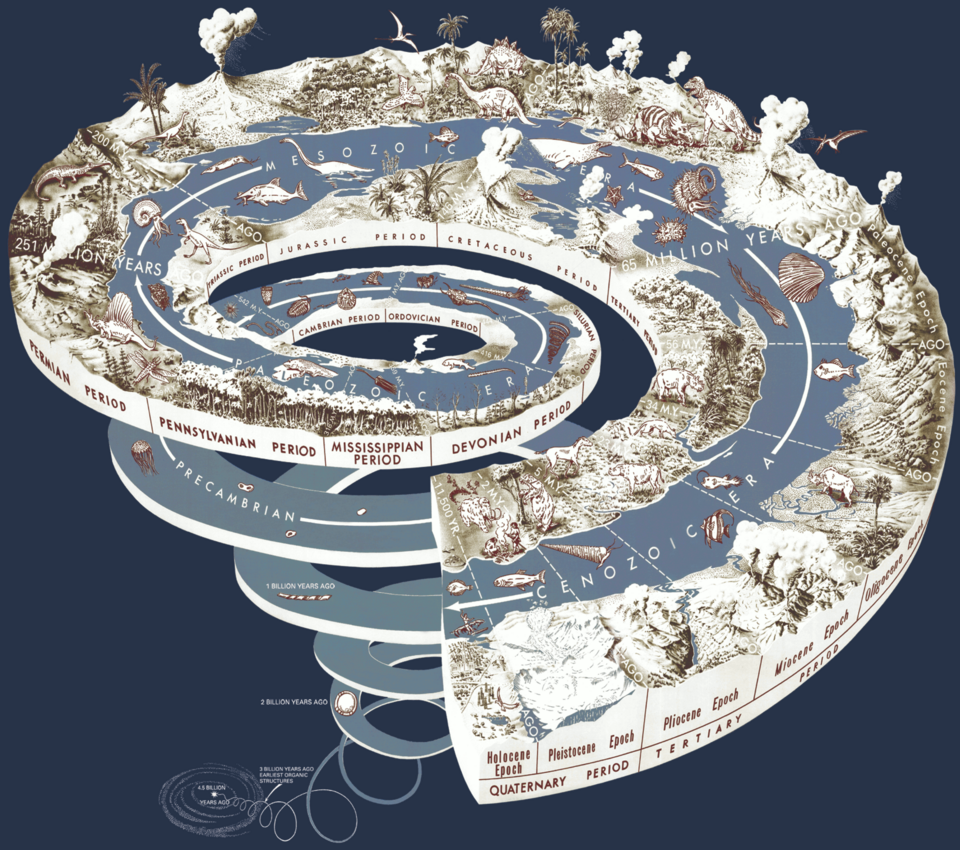
Step back from the flood question and the rock record tells a far longer story — 4.6 billion years, five great extinctions, and 230 million years of dinosaurs, all independently dated. These ages are not guesses: they come from radiometric clocks on volcanic ash cross-checked against the magnetic reversal “barcode” and the clockwork of Earth’s orbit. The ordering is a second, blunt problem for a single-flood model: Triassic faunas never sit above Cretaceous ones.
Geological time spiral
Fig. 14 — The geological time spiral. Only the final ~539 million years — the Phanerozoic — carry abundant animal fossils; the preceding ~88% of Earth’s history is almost entirely microbial.U.S. Geological Survey, public domain, via Wikimedia Commons.
Table 4 — The deep-time framework (ICS chart v2023/09 ages). Era boundaries coincide with mass extinctions because that is where faunas change most abruptly.
Eon / EraSpanSignature events
Hadean4.567–4.0 GaEarth forms; oldest zircons ~4.4 Ga (Jack Hills)
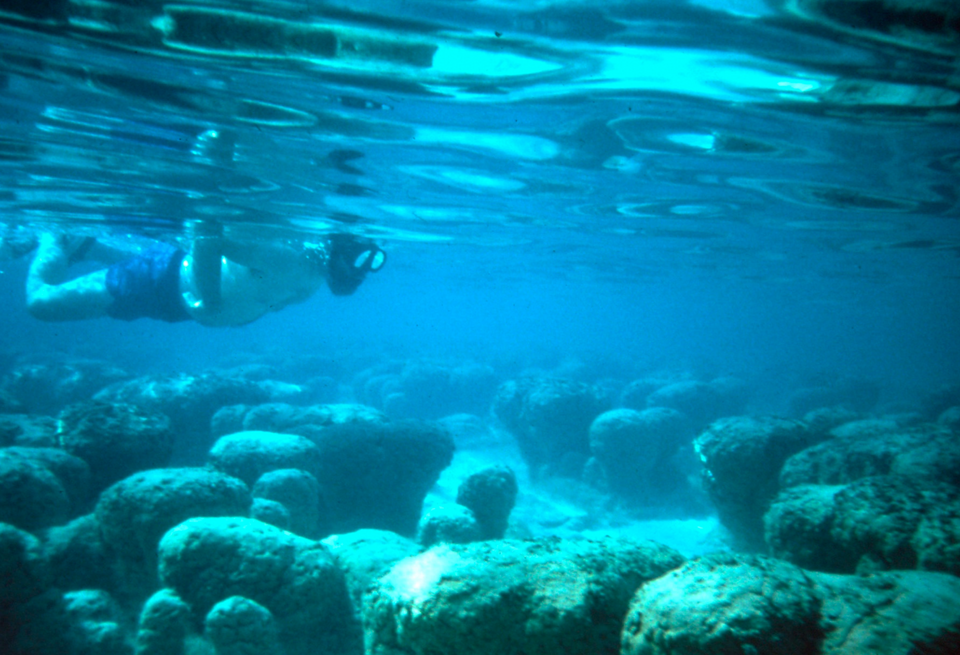
Archean4.0–2.5 GaEarliest secure life ~3.5 Ga (stromatolites)
Proterozoic2.5 Ga–538.8 MaGreat Oxidation Event ~2.43 Ga; first animals (Ediacara)
Paleozoic538.8–251.9 MaCambrian Explosion; ends in the “Great Dying”
Mesozoic251.9–66.0 MaAge of dinosaurs; ends at Chicxulub
Cenozoic66.0 Ma–presentAge of mammals; Homo sapiens in the last 0.3 Ma
Living stromatolites, Shark Bay, Western Australia
Fig. 15 — Living stromatolites at Shark Bay — layered microbial mounds. Their fossil counterparts at ~3.5 Ga are the oldest secure evidence of life, pushing biology back into the Archean.Photo: Landing & Johnson (2024), CC BY 4.0, via Wikimedia Commons.
  • The oldest things we can touch, and the oldest life we can read, are both astonishingly ancient. Established oldest-life detail debated The oldest dated terrestrial material is a ~4.4-billion-year-old detrital zircon from the Jack Hills, Australia, whose oxygen isotopes imply liquid water within ~150 Myr of Earth’s formation (Wilde et al. 2001, Nature 409; confirmed atom-by-atom by Valley et al. 2014, Nature Geoscience 7). Secure evidence of life appears by ~3.5 Ga in the Pilbara’s Dresser Formation; a contested claim at ~3.7 Ga (Isua, Greenland) remains disputed. The Great Oxidation Event (~2.43–2.22 Ga) then permanently added free oxygen, and the Cambrian Explosion (~539–520 Ma) produced most animal body plans over ~20–25 Myr — rapid, but not instantaneous.
  • There have been five great extinctions, and the framework comes from a single 1982 statistical study. Established Raup & Sepkoski (1982, Science 215) isolated five extinction peaks above the background rate. The End-Ordovician (~444 Ma, glaciation) erased ~85% of marine species in two pulses; the Late Devonian (~372 Ma) was a protracted cluster of anoxic crises; the End-Triassic (~201 Ma) removed ~half of marine genera to CAMP volcanism — and, crucially, cleared the niches into which dinosaurs then radiated. Magnitude figures are genuinely sensitive to taxonomic level and sampling, which is why the end-Permian species estimate was later revised (next card).
  • The worst catastrophe in the history of animal life was volcanic, not a flood — and its date is pinned to ~60,000 years. Established magnitude debated The End-Permian “Great Dying” is dated by high-precision zircon geochronology to 251.9 Ma, with the main pulse lasting ≤ 60 ± 48 kyr (Burgess, Bowring & Shen 2014, PNAS 111). Its cause is the Siberian Traps, the largest continental flood basalts of the Phanerozoic, which intruded a carbon- and salt-rich basin and triggered runaway warming, ocean acidification and anoxia. The long-quoted magnitude of ~90–96% of marine species (Raup 1979) was re-analysed by Stanley (2016, PNAS 113) to ~81%; the honest range is ~81–96%, and it remains the largest biotic collapse by any measure.
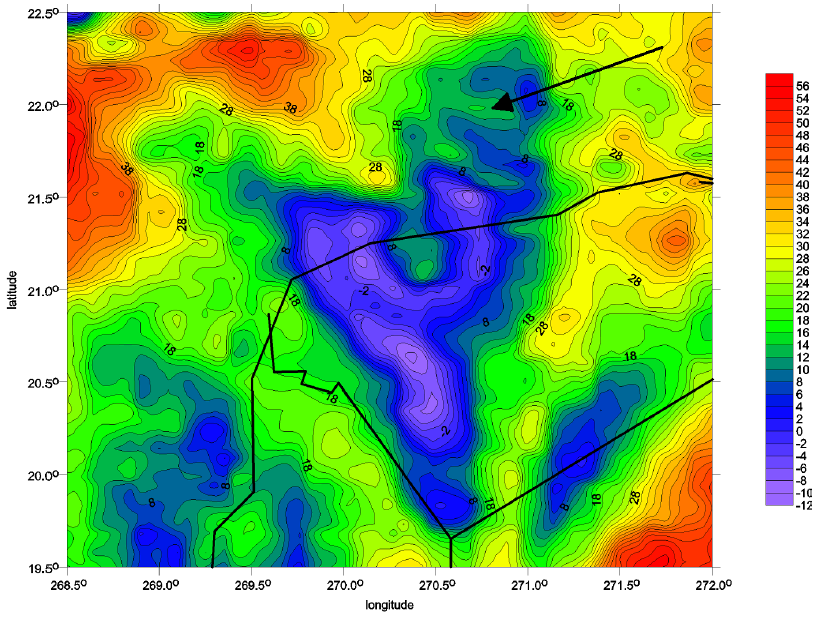
  • Only one of the Big Five has a confirmed cause from space, and the impact and extinction are synchronous to within ~32,000 years. Established The End-Cretaceous (K–Pg) event, 66.0 Ma, killed ~76% of species including all non-avian dinosaurs. Alvarez et al. (1980, Science 208) found an iridium spike in the boundary clay and proposed a ~10-km asteroid; Hildebrand et al. (1991, Geology 19) identified the ~180-km Chicxulub crater under the Yucatán. Renne et al. (2013, Science 339) dated the boundary to 66.043 ± 0.043 Ma and the impact to 66.038 ± 0.049 Ma — statistically indistinguishable, answering the main objection. Whether the roughly contemporaneous Deccan Traps contributed is a live, legitimate debate; the majority view is that the impact was the proximate, dominant cause.
Table 5 — The “Big Five” mass extinctions (Raup & Sepkoski 1982). Dates per ICS; magnitudes as ranges where studies differ.
ExtinctionAgeMagnitudeLeading cause
End-Ordovician~444 Ma~85% marine speciesGlaciation, sea-level fall
Late Devonian~372 Ma~50% generaRepeated ocean anoxia
End-Permian251.9 Ma~81–96% marine speciesSiberian Traps volcanism
End-Triassic~201 Ma~50% generaCAMP volcanism
End-Cretaceous (K–Pg)66.0 Ma~76% speciesChicxulub impact
Gravity-anomaly map of the Chicxulub crater, Yucatán
Fig. 16 — The buried ~180-km Chicxulub crater, revealed as a gravity anomaly beneath the Yucatán. Its age (66.038 Ma) matches the extinction to within ~32,000 years.Klokočník et al., CC BY 3.0, via Wikimedia Commons.
Siberian Traps flood basalt, Putorana Plateau
Fig. 17 — Siberian Traps flood basalt (Putorana Plateau) from the Permian–Triassic boundary, ~251 Ma — the volcanism behind the Great Dying. “Flood basalt” here means lava, not water.Photo: James St. John, CC BY 2.0, via Wikimedia Commons.
  • Dinosaurs arose in the Triassic and ruled for ~135 million years — and their stratigraphic ordering is itself a test of the timescale. Established origin & phylogeny debated The oldest widely accepted dinosaurs (Eoraptor, Herrerasaurus) date to ~231 Ma in Argentina (Martínez et al. 2011, Science 331); a Middle-Triassic candidate, Nyasasaurus (~245 Ma), is either the oldest dinosaur or its closest relative (Nesbitt et al. 2013). The Late Jurassic Morrison fauna (Stegosaurus, Allosaurus, giant sauropods, ~155–148 Ma) and the latest-Cretaceous Hell Creek fauna (Tyrannosaurus, Triceratops, ~68–66 Ma) are never found in reversed order — exactly the independent check a sorting-by-density flood cannot pass. Even the dinosaur family tree’s root is an open controversy (the traditional Saurischia/Ornithischia split vs. the 2017 “Ornithoscelida” proposal, Baron et al., Nature 543).
  • Dinosaurs are not entirely extinct — birds are living theropods, documented by feathered fossils. Consensus Archaeopteryx (~150 Ma, Solnhofen) combines theropod features with flight feathers, and the Early Cretaceous Jehol biota (~125 Ma, China) preserves feathers on non-flying dinosaurs — simple filaments on Sinosauropteryx (Chen et al. 1998, Nature 391) and the four-winged Microraptor (Xu et al. 2003, Nature 421). The nested anatomical, developmental and molecular evidence places birds firmly within the theropods, so the ~11,000 living bird species are the surviving dinosaur lineage. All non-avian dinosaurs vanished precisely at the K–Pg boundary clay; claimed “Paleocene dinosaurs” are reworked older fossils.
  • Four independent clocks agree on these dates — which is why the deep-time framework is considered secure. Established Absolute anchors come from U–Pb on zircon and ⁴⁰Ar/³⁹Ar on ash beds and tektites (the basis for the 251.9 Ma and 66.04 Ma ages). These are correlated worldwide by the magnetic-reversal barcode (globally synchronous polarity flips) and by biostratigraphy (ordered index fossils), and validated to the thousand-year level by astrochronology — counting Milankovitch orbital cycles in the sediment. Radiometric, magnetic, biostratigraphic and orbital methods are four physically independent systems, and their agreement is the strongest reason the timescale is trusted.
Mounted Tyrannosaurus rex skeleton
Fig. 18 — Tyrannosaurus rex, from the latest-Cretaceous Hell Creek Formation (~68–66 Ma). Its fossils stop exactly at the iridium boundary clay — a geologically instantaneous end.Photo: Gary Todd, CC0, via Wikimedia Commons.
Polished ammonite fossil
Fig. 19 — An ammonite — one of the great index-fossil groups. Their rapid evolution and wide dispersal let geologists correlate Mesozoic rock between continents; they, too, vanished at the K–Pg boundary.Photo: Amir Ali Iranshahi, CC0, via Wikimedia Commons.
↓ This is the planet’s deep biography. Against 4.6 billion years, where does humanity fall — and could anyone have been present to witness a flood worth remembering? ↓

In one breath: the rocks record 4.6 billion years, five great die-offs (the worst volcanic, the last from an asteroid dated to the extinction within 32,000 years), and 230 million years of dinosaurs whose fixed stratigraphic order no flood could sort — all cross-checked by four independent clocks.

§7Human Prehistory — Who Could Witness a Flood?— 300,000 years of Homo sapiens, the Ice Age, the drowning of the shelves, and the 5,000-year-old invention of writing.

Now the two halves of the problem meet. Our species is roughly 300,000 years old; writing is only ~5,000. That gap of ~295,000 years is the crucial space the flood legends live in: any real flood a human saw had to travel by oral memory — sometimes for millennia — before anyone could write it down. This section fixes the human timeline, the Ice Age and the drowning of the shelves, and the Mesopotamian flood silts that may be the kernel of the story.
Lascaux cave painting, Upper Paleolithic
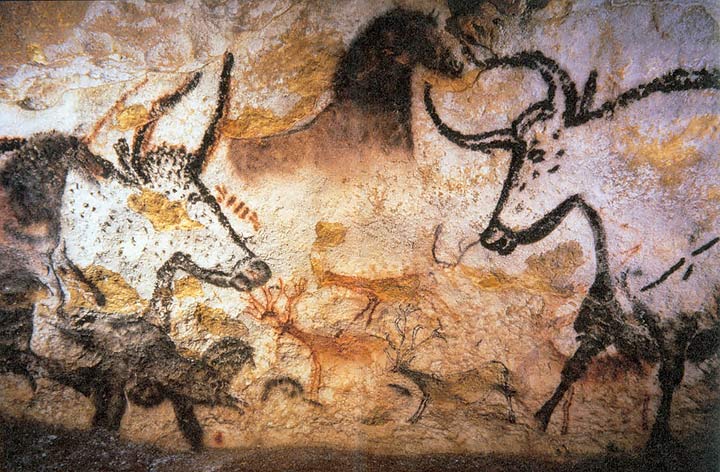
Fig. 20 — Lascaux (~17,000 years old). By the Upper Paleolithic humans plainly possessed symbolic culture and durable oral tradition — the machinery needed to carry the memory of a catastrophe across generations.Public domain, via Wikimedia Commons.
  • Modern humans existed for a quarter-million years before the first word was ever written. Established The 2017 re-dating of Jebel Irhoud, Morocco, placed Homo sapiens fossils at 315 ± 34 ka (Hublin et al. 2017, Nature 546), pushing our origin back ~100,000 years and across the continent from the old East-African benchmark. Whether “behavioural modernity” (art, ornament, complex tools) arrived suddenly or assembled gradually is genuinely debated, but by the Upper Paleolithic humans unambiguously had language and durable oral culture. For the flood question this is a floor, not a proof: a species this old could in principle carry a memory across an almost unimaginable span before it reached a tablet.
  • Humans were seafaring to Australia ~65,000 years ago and living in the Americas during the Ice Age — the capacity for long memory is matched by deep antiquity. Established exact figures argued Madjedbebe in Arnhem Land sets a minimum arrival in Australia of ~65 ka (Clarkson et al. 2017, Nature 547), requiring open-water crossings even at low glacial sea level. In the Americas, fossil footprints at White Sands date to ~21–23 ka — and the once-fierce dating dispute was resolved in 2023 by two independent clocks (terrestrial pollen radiocarbon and quartz luminescence) agreeing with the original seed ages (Bennett et al. 2021 / Pigati et al. 2023, Science). People were spread across the globe, each population positioned to meet — and remember — its own local floods.
  • The Ice Age ended in a slow, pulsed meltdown that raised the sea ~120 metres and drowned whole inhabited lands. Established The Last Glacial Maximum peaked ~26,500–19,000 years ago (Clark et al. 2009, Science 325), after which deglaciation lifted global sea level by about 120–134 m before stabilising ~7,000 years ago (Lambeck et al. 2014, PNAS 111). Doggerland, Sundaland, Beringia and the floor of the Persian Gulf — all inhabited lowlands — went under. This is the physically real “great flooding” of prehistory: slow in a single lifetime, but relentless, and punctuated by sudden losses of coast and island. Meltwater Pulse 1A (~14.6 ka) was fast enough — ~14–18 m in a few centuries — to have been felt as a sudden inundation within living memory.
  • The drowned Persian Gulf is a real lost homeland in exactly the Mesopotamian catchment — a plausible substrate for a “world flooded” memory. Model At the glacial low stand the Gulf floor was a well-watered lowland fed by the Tigris, Euphrates and Karun, habitable and very likely inhabited, before the Indian Ocean flooded it to roughly its modern shoreline by ~8,000 years ago. Rose (2010, Current Anthropology 51) documented a sudden florescence of coastal settlements around the basin precisely as it drowned — consistent with populations displaced by the rising water. This proves nothing about any specific legend, but it establishes that people in the Mesopotamian cultural world really did lose an entire homeland to water within the Holocene.
  • Writing was invented only ~3,300 BCE — and that single fact governs the entire flood-legend chronology. Established The earliest cuneiform (archaic Uruk IV tablets) dates to ~3400–3100 BCE and began as accounting before it could carry narrative; Egyptian notation appears at essentially the same era. The decisive implication is blunt: no flood story could be written before anything could be written. Any flood witnessed during deglaciation (ending ~7 ka) was necessarily transmitted orally for thousands of years before it could reach a tablet — if it reached one at all. The entire record of literate civilisation occupies only the most recent ~5% of our species’ existence (Holocene base fixed at 11,700 years ago, Walker et al. 2009).
  • Mesopotamian cities really do sit on flood silts — but they are local river floods of different dates, not one global event. Established fact interpretation In 1929 Leonard Woolley struck a ~3-metre band of clean, artifact-free flood silt at Ur and announced he had found Noah’s flood. Similar water-laid clays separate occupation phases at Shuruppak, Kish and Uruk — but at different depths and different dates (Woolley’s Ur layer ~3500 BCE; Shuruppak/Kish ~2900 BCE; later floods at Kish ~2600–2400 BCE). Max Mallowan’s careful reassessment (“Noah’s Flood Reconsidered,” Iraq 26, 1964) concluded they cannot be one synchronous flood — each is the ordinary, if severe, behaviour of the Tigris and Euphrates on a flat plain. He nonetheless took seriously that a major flood at Shuruppak — the very city the Sumerian tradition names as the flood hero’s home — could be the historical kernel behind the literary deluge.
↓ So real floods were witnessed, remembered orally for millennia, and only later written — which finally lets us answer the opening question: why does the whole world remember a flood? ↓

In one breath: humans are ~300,000 years old and literate for only ~5,000, so the real Ice-Age inundations — 120 metres of rising sea, the drowning of Doggerland and the Persian Gulf, the recurrent Shuruppak river floods — were witnessed and carried orally for millennia before any of them could be written down.

§8Synthesis — Why the World Remembers a Flood— independent origin vs. diffusion vs. real shared memory; and the honest apologetic bottom line.

Everything above converges here. The world does remember a flood — that much is real and worth taking seriously. The honest question is why, and there are five candidate explanations, not one. The truth is almost certainly a layered combination of them, and sorting out which carries weight is exactly where popular treatments (on both sides) go wrong.

  • (a) Independent invention — floods are the commonest disaster, and nearly everyone lives near water. Consensus factor The most parsimonious reason flood stories are near-universal is that destructive floods are near-universal: riverine, coastal and lacustrine communities everywhere experience inundation, and a flood that destroys “the world” means the known local world. Folklorists treat the deluge as a textbook case where independent generation must be the default before diffusion is invoked, because typological similarity alone — “there was a flood, a few survived” — is far too thin to prove common descent (Dundes, ed., The Flood Myth, 1988). This is why structurally alien stories (China’s dredging engineer, the Norse blood-flood, the earth-divers) are the strongest evidence that flood myths arise more than once.
  • (b) Diffusion from a Mesopotamian prototype — for one tight cluster, the detail is too specific to be coincidence. Debated, but strong for the cluster Among the Sumerian, Akkadian (Atrahasis, Gilgamesh XI) and Hebrew tellings, the shared motifs — divine warning, a built vessel, animals aboard, birds sent to find land, a mountain landing, a sacrifice afterward — are too detailed and too geographically concentrated to be accidental, and the direction of dependence runs from the older Mesopotamian texts toward the later Hebrew one. But extending this single family to all the world’s flood tales is unwarranted; the global distribution is not one tradition radiating outward from Iraq.
  • (c) Genuine shared memory of a real inundation — and in at least one case this is demonstrable. Model (one case Established) Distinct from both invention and literary diffusion is the possibility that some traditions encode an actual witnessed event preserved orally — the drowning coastlines of deglaciation (the Gulf, Sundaland, Doggerland) or the Shuruppak flood horizon Mesopotamian tradition itself localises. The proof-of-concept is Australian: see the next card. This explanation illuminates how a true catastrophe becomes a story, but it does not, by extension, validate every flood narrative as history.
  • (d) Later missionary/European contamination — a large share of New-World and Pacific tales. Likely post-contact Many flood stories in the Americas, the Pacific and parts of Africa were recorded after sustained contact with Bible-carrying missionaries, and some show tell-tale borrowings (an ark, a dove, a covenant rainbow) hard to credit as pre-contact — Hawaii’s “Nu‘u” is the textbook case (Beckwith 1940 noted its “strain after biblical analogy”). Responsible comparison discounts post-contact tellings, and when it does, the uncritical “hundreds of legends all confirm Noah” apologetic collapses: the real count of robustly independent, pre-contact flood traditions is far smaller than the popular totals and cannot be stated precisely.
  • (e) The Jungian/archetypal reading — the flood as a symbol of dissolution and rebirth. Speculative On this view the recurrence reflects shared mind, not shared history — a universal symbolic grammar in which water means chaos, judgment and renewal. It is unfalsifiable and explains the emotional resonance of flood stories better than their distribution; it is interesting as hermeneutics, not as evidence, and must be graded Speculative.
The empirical anchor — Nunn & Reid 2016 At least one culture demonstrably preserved a true flooding event for 7,000+ years by word of mouth. Established & striking Patrick Nunn and Nicholas Reid (Australian Geographer 47, 2016) compiled stories from ~21 Aboriginal groups around the entire Australian coastline describing a time when the shore lay farther out and the sea rose to drown former land. Because Australian sea level reached its present stand ~7,000 years ago and has not been higher since, these geographically specific stories must encode events at least that old — the authors estimate a range of roughly 7,250–13,070 years. It is the best real-world evidence that long oral transmission of a true flood can happen. Honesty caveat: even the authors frame the longevity as remarkable and partly inferential — it shows millennia-scale transmission is possible, not that every flood legend achieved it. Note, too, that these describe local marine transgression — evidence against reading every “water covered the land” story as one global deluge.
The “95% / 88% / 70%” statistics — handle with care The famous flood-legend percentages are a creationist recoding, not neutral scholarship, and are statistically worthless as proof of one global flood. Provenance established; proof-value nil The corpus of ~200 traditions is real ethnography (Andree 1891; Frazer 1918) — but Andree’s own 1891 tally already found nearly half with no biblical resemblance. The specific percentage set (95% worldwide, 88% a favoured family, 70% a boat…) was popularised by the Institute for Creation Research and traces through Byron Nelson’s The Deluge Story in Stone (1931), an explicit flood-geology apologetic. The numbers fail on three counts: selection bias (assembled to demonstrate Noah), loose coding (a hollow log and a mill-chest both counted as “a boat”; local lake floods counted as “worldwide”), and inclusion of contaminated tales (counting retold Genesis as independent corroboration — the Bible confirming itself). The decisive counter-fact: sub-Saharan Africa, humanity’s deepest homeland, is comparatively empty of native flood myths — the opposite of what a true universal memory of one global flood would produce. Cite these numbers only to critique them.
The honest bottom line The worldwide convergence of flood traditions is real and genuinely interesting — Model-level evidence of a shared human experience of catastrophic flooding — but it does not, by itself, establish a single 40-day global flood that laid down the geological strata. Model for the convergence global-flood inference not supported What the evidence actually supports is layered: (1) floods are the commonest disaster for a water-dwelling species, so some convergence is expected by independent invention alone; (2) a tight Near-Eastern cluster shares distinctive motifs best explained by diffusion from a Mesopotamian prototype; (3) at least one tradition (Aboriginal Australia) demonstrably preserves a true flooding event across millennia; (4) real, human-witnessed mega-inundations did occur — the ~120 m post-glacial rise, Meltwater Pulse 1A, the drowning of the Gulf, Doggerland and Sundaland, and recurrent Mesopotamian river floods — any of which could seed a “the world was flooded” memory in the people it displaced. None of these, singly or summed, is a planet-covering event depositing the global column; the record shows pulsed deglacial rise and local river silts of different dates, not one synchronous worldwide deluge.
On the biblical account — distinctive without overclaiming Two things are true at once, and honesty requires holding both. Chronology established First, the chronology is decisive and must be stated plainly: the Mesopotamian flood texts demonstrably predate Genesis as written documents (Atrahasis is fixed to c. 1646–1626 BCE by its own colophon; the Sumerian tradition is older still), and the detailed shared motifs make literary relationship, not coincidence, the parsimonious reading — with dependence running from the earlier Mesopotamian material toward the later Hebrew text. Second, the Genesis flood is theologically different in kind from its neighbours: one sovereign, moral God acting in righteous judgment and covenant mercy, rather than capricious gods annoyed by human noise; a universal ethical framing rather than a local royal legend. That theological distinctiveness is a real and defensible feature of the text, and it is fully consistent with a God who acts in and through real history. But it is a claim about meaning, not about global stratigraphy — and it should never be smuggled in as geological proof of a worldwide flood that the rocks do not show.

In one breath: the world remembers a flood because floods are universal, because one Near-Eastern family of stories really did diffuse, because at least one people truly kept the memory of rising seas for millennia, and because the Ice Age really did drown inhabited coasts — a layered, honest answer that honours both the data and the biblical text without pretending the strata were laid in a year.

§9Sources, Honesty Notes & Image Credits— the key references, the methodological caveats, and full public-domain image attribution.

This document was assembled from peer-reviewed primary literature, standard critical editions, and museum catalogues. Every date, discharge figure, accession number and percentage was checked against a named source; where a claim could not be anchored to a real reference it was omitted rather than estimated. Below are the key references by section, the standing honesty caveats, and full attribution for every image.

9.1 Key references by section

  • Flood texts (§1–2): Lambert & Millard, Atra-ḫasīs (1969); A. R. George, The Babylonian Gilgamesh Epic (2003); Irving Finkel, The Ark Before Noah (2014); Jacobsen, JBL 100 (1981); Tigay, The Evolution of the Gilgamesh Epic (1982); Frymer-Kensky, Biblical Archaeologist 40 (1977); Wellhausen (1883); Westermann, Genesis 1–11 (1984); Wenham, VT 28 (1978); M. L. West, The East Face of Helicon (1997).
  • World legends (§1, §8): Shatapatha Brahmana 1.8.1; Wu et al., Science 353 (2016) + Han Jianye Comment & Response (2017); Dundes (ed.), The Flood Myth (1988); Dundes, American Anthropologist 64 (1962); Frazer, Folk-Lore in the Old Testament I (1918); Andree, Die Flutsagen (1891); Beckwith, Hawaiian Mythology (1940); Nelson, The Deluge Story in Stone (1931).
  • Megafloods (§3): Bretz, J. Geol. 31 (1923); Pardee, GSA Bull. 53 (1942); O’Connor & Baker, GSA Bull. 104 (1992); Waitt, GSA Bull. 96 (1985); García-Castellanos et al., Nature 462 (2009); Ryan et al., Marine Geology 138 (1997); Aksu et al., GSA Today 12 (2002); Giosan et al., QSR 28 (2009); Barber et al., Nature 400 (1999); Weninger et al., Documenta Praehistorica 35 (2008); Rudoy & Baker, Sedimentary Geology 85 (1993); Deschamps et al., Nature 483 (2012); Fairbanks, Nature 342 (1989); Lambeck et al., PNAS 111 (2014); Clark et al., Science 325 (2009).
  • Stratigraphy & flood-geology audit (§4–5): Steno (1669); Hutton (1788); Lyell (1830–33); W. Smith (1815); Patterson (1956); Dalrymple, The Age of the Earth (1991); Anderson et al., GSA Bull. (1972); Bradley, USGS PP 158 (1929); Krijgsman et al., Nature (1999); Hsü et al., Nature (1973); Newell et al. (1953); Retallack, Soils of the Past (2001); Horner & Makela, Nature (1979); Whitcomb & Morris, The Genesis Flood (1961); Austin (1986/1994); Snelling (2009); Vardiman, Snelling & Chaffin (eds.), RATE vol. 2 (2005); Wiens, “Radiometric Dating: A Christian Perspective” (2002).
  • Deep time, extinctions, dinosaurs (§6): ICS Chart v2023/09; Wilde et al., Nature 409 (2001); Raup & Sepkoski, Science 215 (1982); Burgess, Bowring & Shen, PNAS 111 (2014); Stanley, PNAS 113 (2016); Blackburn et al., Science 340 (2013); Alvarez et al., Science 208 (1980); Hildebrand et al., Geology 19 (1991); Schulte et al., Science 327 (2010); Renne et al., Science 339 (2013); Martínez et al., Science 331 (2011); Baron et al., Nature 543 (2017); Xu et al., Nature 421 (2003).
  • Human prehistory & synthesis (§7–8): Hublin et al., Nature 546 (2017); Clarkson et al., Nature 547 (2017); Bennett et al., Science 373 (2021) + Pigati et al., Science 382 (2023); Walker et al., J. Quaternary Science 24 (2009); Rose, Current Anthropology 51 (2010); Mallowan, “Noah’s Flood Reconsidered,” Iraq 26 (1964); Woolley, Excavations at Ur (1954); Nunn & Reid, Australian Geographer 47 (2016).

9.2 Standing honesty caveats

  • Earliest copy ≠ date of composition. Paleography dates the artifact; the story may be older (oral) or no older than the copy. The two are kept separate in Table 2.
  • The “~200 legends / 95%” statistics are not neutral scholarship — they are an ICR/Nelson recoding with selection bias, loose coding and contaminated entries; used here only to be critiqued (§8).
  • The Black Sea “deluge” is contested, trending negative — a real marine reconnection, but the catastrophic deep-flood version is a minority reading (§3).
  • End-Permian magnitude genuinely varies between studies (~81% vs ~90–96%); the dinosaur family tree’s root and the Deccan-vs-Chicxulub contribution are live debates (§6).
  • Whether a biblical 4QGen scroll preserves the flood chapters is unverified; the dependable Qumran flood witness is the commentary 4Q252 (§2).
  • Meltwater Pulse 1A is a centuries-scale eustatic rise, not an hours-scale wall of water; the drowned-landmass list must not be collapsed into one synchronous event (§3, §7).
  • Grade badges are the whole point. Nothing here rests on authority: the datings, mechanisms and citations are given so the reader can check them, and the strongest claims (Established) are separated from the weakest (Speculative) and from young-earth claims the evidence does not support (YEC).

9.3 Image credits

All images are genuine public-domain or Creative-Commons works downloaded from Wikimedia Commons (descriptive user-agent per Wikimedia policy); none are fabricated. Each is reproduced under its stated license with attribution.

Table 6 — Image provenance (all via Wikimedia Commons).
Fig.SubjectCreator / sourceLicense
1Gilgamesh Flood Tablet (BM K.3375)Photo: Mike PeelCC BY-SA 4.0
2Noah’s Ark (1846)Edward HicksPublic domain
3Matsya towing Manu’s boatUnknown artistPublic domain
4Yu the GreatAttrib. Ma LinPublic domain
5Atrahasis flood tabletPhoto: SpeakingArchCC BY-SA 4.0
6Deucalion & Pyrrha (1636)Peter Paul RubensPublic domain
7Dry Falls, WashingtonPhoto: IkiwanerCC BY-SA 3.0
8Giant current ripples, Camas PrairiePhoto: Paul H.CC BY 4.0
9Strait of Gibraltar (satellite)Axelspace CorporationCC BY-SA 4.0
10Doggerland map (c. 10,000 BP)Polaris999 (after Quizimodo)Public domain
11Grand Canyon stratigraphic columnU.S. National Park ServicePublic domain
12Hutton’s Unconformity, Siccar PointPhoto: Lisa Jarvis (geograph)CC BY-SA 2.0
13Geological map of Britain (1815)William SmithCC0
14Geological time spiralU.S. Geological SurveyPublic domain
15Living stromatolites, Shark BayLanding & Johnson (2024)CC BY 4.0
16Chicxulub crater gravity anomalyKlokočník et al.CC BY 3.0
17Siberian Traps basalt, PutoranaPhoto: James St. JohnCC BY 2.0
18Tyrannosaurus rex skeletonPhoto: Gary ToddCC0
19Polished ammonite fossilPhoto: Amir Ali IranshahiCC0
20Lascaux cave paintingPublic-domain reproductionPublic domain

Bottom line: the flood-legend convergence is a real and fascinating datum about shared human memory; genuine megafloods are written in the rock; and the deep-time fossil record is secured by four independent clocks — three true things that fit together only when each is graded honestly and none is forced to carry more than it can bear.

How to read this document. Sections are collapsed by default — open the ones you want, or hit Expand all. Every substantive claim carries a colored grade badge; the strongest claims are Established facts, the weakest are Speculative, and young-earth flood-geology claims that the evidence does not support are marked YEC and answered on the spot. Nothing here is an argument from authority: the datings, mechanisms and citations are given so you can check them.

GodExamined research desk · local study document · generated 2026-10-22.